

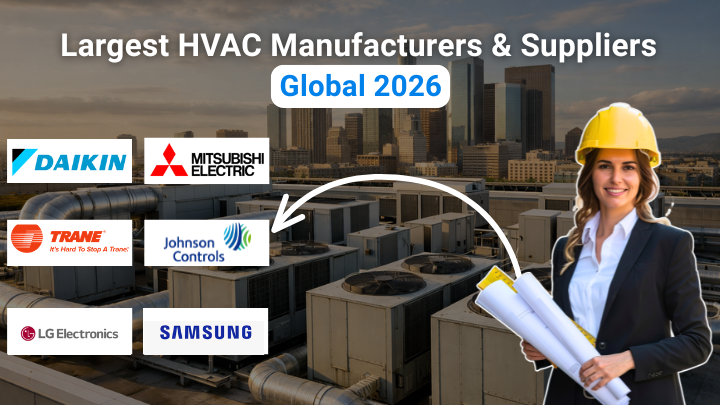
This blog analyzes the largest and leading commercial HVAC manufacturers globally in 2026, based on manufacturing scale, equipment dominance, and market presence. It distinguishes major global manufacturers from suppliers and explains how commercial and residential HVAC systems differ in scale and application. The report also highlights industry trends shaping the HVAC landscape, including efficiency, electrification, and large-scale commercial infrastructure growth.
Supplier Delays Can Turn a Winning HVAC Order Into a Costly Delay.Large HVAC projects depend on dependable sourcing, supplier coordination, and material availability.
Request a Demo Become a Distributor Get 14 days of full access with no credit card required. |
Largest and Top Commercial HVAC Manufacturers
The global HVAC industry continues to expand across residential, commercial, and industrial sectors, driven by urban development, infrastructure modernization, energy-efficiency standards, and rising demand for climate control systems. From high-rise office towers and hospitals to manufacturing plants and residential housing, HVAC systems form the operational backbone of modern buildings.
The largest HVAC manufacturers operate at multi-continent scale, producing equipment such as chillers, rooftop units (RTUs), variable refrigerant flow (VRF) systems, split systems, heat pumps, and air handling units. These companies maintain extensive manufacturing facilities, global distribution networks, and the capability to support large commercial and institutional projects worldwide.
Alongside manufacturers, global HVAC suppliers and distributors connect contractors and commercial buyers with equipment, replacement parts, and technical support. Together, manufacturers and suppliers power the heating and cooling infrastructure of 2026.
This industry report examines the largest HVAC manufacturers and major global HVAC suppliers based on manufacturing footprint, commercial project scale, and equipment category dominance.
What Defines the Largest HVAC Manufacturers?
In industry terms, ???largest??? does not refer to brand recognition alone. For this analysis, the largest HVAC manufacturers are defined by three core factors:
Global Manufacturing Footprint
Companies operating production facilities and distribution networks across multiple continents.Commercial Project Scale
Manufacturers capable of supporting high-capacity systems for hospitals, airports, industrial facilities, data centers, retail complexes, and institutional infrastructure.Equipment Category Dominance
Strong presence across major HVAC equipment categories, including chillers, VRF systems, rooftop units, heat pumps, split systems, and air handling solutions.
The manufacturers below meet these criteria and are structured into dominance bands based on global operational scale.
Tier 1 Global HVAC Manufacturers (2026)
Global HVAC Leaders
These manufacturers represent the highest global HVAC scale, combining broad equipment portfolios with strong commercial and residential presence worldwide.
Daikin Industries
Daikin Industries operates one of the most extensive HVAC manufacturing networks globally. The company produces residential split systems, VRF systems, commercial rooftop units, large-capacity chillers, and applied industrial cooling equipment. Daikin maintains production and distribution facilities across Asia, North America, Europe, and the Middle East, serving both residential and complex commercial developments.
Carrier Global
Carrier Global manufactures a comprehensive portfolio of commercial chillers, rooftop units, air handlers, VRF systems, and residential heating and cooling systems. Its equipment is widely specified for healthcare facilities, airports, commercial real estate, and infrastructure projects. Carrier operates in more than 160 countries with global manufacturing and service networks.
Trane Technologies
Trane Technologies produces high-performance commercial HVAC systems through its Trane brand, alongside residential systems under American Standard. Its applied systems include water-cooled and air-cooled chillers, large air handling units, and custom commercial climate solutions used in data centers, universities, and industrial facilities.
Johnson Controls
Through its YORK brand and building technologies division, Johnson Controls manufactures large commercial HVAC systems, chillers, air handling units, and integrated building climate infrastructure. The company supports infrastructure-intensive sectors including hospitals, airports, and industrial complexes across North America, Europe, Asia, and the Middle East.
Commercial & Technology Specialists
These manufacturers demonstrate strong global influence in specific HVAC equipment categories, particularly in advanced and high-efficiency systems.
Mitsubishi Electric
Mitsubishi Electric is a leader in ductless mini-split and VRF systems, known for inverter-driven technology and zoning capabilities. Its systems are widely deployed in energy-efficient residential buildings, mixed-use developments, and commercial properties requiring flexible climate control.
LG Electronics
LG???s HVAC division specializes in advanced VRF systems, ducted solutions, heat pumps, and smart climate integration technologies. LG equipment is increasingly used in urban commercial developments and high-efficiency building projects.
Samsung Electronics
Samsung???s HVAC division manufactures VRF systems, ductless air conditioners, and integrated climate technologies tailored for smart buildings and high-density residential developments. The company continues to expand its commercial HVAC footprint globally.
North America???Dominant & Regional Powerhouses
These manufacturers maintain strong regional manufacturing presence with broad contractor distribution networks.
Lennox International
Lennox International produces residential and light commercial HVAC systems including rooftop units, packaged systems, furnaces, and air conditioners. It maintains a strong distribution footprint across North America and serves contractor-driven markets extensively.
Rheem Manufacturing
Rheem manufactures residential and commercial heating and cooling systems, including split systems and packaged equipment. Its products are widely distributed in North America and selected international markets, particularly in retrofit and mid-market commercial segments.
Bosch Thermotechnology
Bosch Thermotechnology manufactures high-efficiency heat pumps, boilers, and compact HVAC systems for residential and light commercial markets. The company emphasizes sustainability and energy-efficient system design, particularly across Europe and North America.
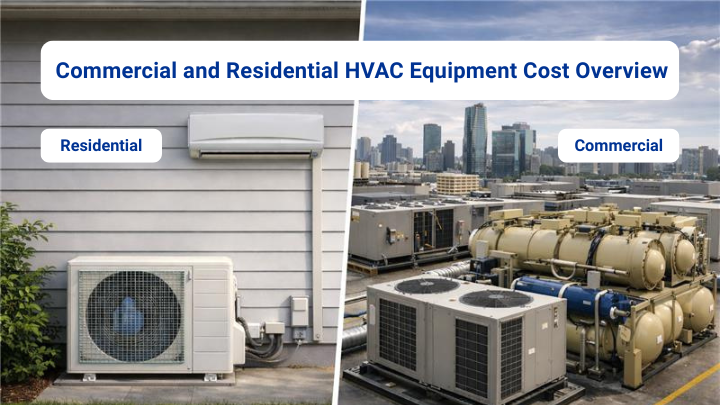
Commercial and Residential HVAC Equipment Cost Overview
Understanding equipment categories helps clarify how the largest HVAC manufacturers compete across segments.
Typical HVAC Equipment Cost Ranges (Equipment Only)
| Equipment Type | Typical Cost Range | Primary Use |
| Split Systems | $2,500 ??? $7,500 | Residential homes |
| Packaged Units | $3,000 ??? $8,000 | Small commercial |
| Rooftop Units (RTU) | $6,000 ??? $20,000+ | Commercial buildings |
| VRF Systems | $15,000 ??? $60,000+ | Multi-zone commercial & mixed-use |
| Chillers | $30,000 ??? $500,000+ | Large commercial & industrial |
| Air Handling Units | $5,000 ??? $50,000+ | Commercial & institutional |
| Heat Pumps | $3,000 ??? $12,000 | Residential & light commercial |
Costs vary by capacity, configuration, and installation complexity.
Major Global HVAC Suppliers & Distributors
Manufacturers rely on distribution networks to supply contractors and commercial buyers.
Watsco
Watsco is one of the largest HVAC distributors in North America, supplying major manufacturer brands through hundreds of branches serving residential and commercial contractors.
Ferguson
Ferguson distributes commercial and residential HVAC equipment and components across the United States, supporting contractors with large-scale logistics and inventory systems.
Johnstone Supply
Johnstone Supply operates hundreds of wholesale HVAC locations across the U.S. and Canada, offering multi-brand access to contractors and service providers.
Reece Group
Reece Group distributes HVAC and plumbing equipment across Australia, New Zealand, and the United States, supporting regional contractor networks.
Winsupply
Winsupply operates a network of independently owned wholesale companies across the U.S., providing HVAC equipment sourcing and regional logistics.
Wolseley
Wolseley distributes HVAC and building materials across the UK and Europe, supporting commercial and industrial construction projects.
Carrier Enterprise
Carrier Enterprise distributes Carrier-branded HVAC systems and parts throughout North America and Latin America.
Trane Supply
Trane Supply distributes Trane HVAC equipment and replacement components across the United States and Canada.
Lennox Stores
Lennox Stores provides exclusive distribution of Lennox HVAC systems and service parts across North America.
Regional HVAC Manufacturing Leaders
While global manufacturers dominate, regional companies also hold strong positions.
USA: Carrier, Trane
Canada: Strong presence of Lennox and Daikin operations
UK & Europe: Bosch Thermotechnology, Johnson Controls presence
UAE: Regional manufacturing supported by global brands
India: Major presence of global manufacturers alongside domestic brands such as Blue Star and Voltas
2026 HVAC Industry Outlook
The HVAC industry in 2026 continues to evolve toward higher energy efficiency, electrification, and smart system integration. VRF systems and inverter-driven heat pumps are gaining broader adoption in commercial and multi-residential developments. Large infrastructure projects increasingly demand scalable, high-capacity HVAC systems capable of meeting sustainability standards and indoor air quality requirements. As commercial buildings become more technology-driven, manufacturers that combine equipment innovation with system integration capabilities are positioned to maintain market dominance.
How Large HVAC Manufacturers Impact HVAC Business Operations
As HVAC systems become more advanced and diverse, contractors and commercial operators must manage multi-brand equipment, complex installation requirements, and varying cost structures. Large commercial projects often involve coordination between manufacturers, suppliers, and field teams across multiple job sites.
Managing procurement, equipment tracking, job costing, and workflow coordination becomes increasingly complex as system scale grows. Structured business HVAC software helps contractors organize project data, track equipment specifications, and maintain operational visibility across installations.
Duct Architect HVAC software is designed to support HVAC businesses managing commercial and residential projects involving equipment from global HVAC manufacturers. By centralizing project workflows, cost tracking, and job coordination, it provides operational clarity in environments where multi-brand systems and large-scale installations are common.
Conclusion
The largest and top commercial HVAC manufacturers in 2026 are defined by global manufacturing reach, commercial project capability, and dominance across major equipment categories. From chillers and rooftop units to VRF systems and heat pumps, these companies power critical infrastructure across residential, commercial, and industrial markets.
Supported by global suppliers and distributors, they form the backbone of modern heating and cooling systems worldwide. Understanding their scale and specialization helps contractors, developers, and facility operators make informed decisions in an increasingly complex HVAC landscape.
Frequently Asked Questions (FAQs)
Who are the top 5 HVAC manufacturers in 2026?
The top HVAC manufacturers typically include Daikin Industries, Carrier Global, Trane Technologies, Johnson Controls (YORK), and Mitsubishi Electric. These companies maintain extensive global manufacturing networks and strong commercial HVAC presence.
What is the largest HVAC manufacturer in the world?
Daikin Industries and Carrier Global are widely recognized among the largest HVAC manufacturers globally due to their broad manufacturing footprint and strong commercial system dominance.
How many HVAC manufacturers exist globally?
While hundreds of companies produce HVAC equipment worldwide, a relatively small group of multinational manufacturers dominates global commercial and residential markets.
What is the average cost of commercial HVAC equipment?
Commercial HVAC equipment costs vary by system type. Rooftop units may range from $6,000 to $20,000+, while large chillers can exceed $500,000 depending on capacity and configuration.
What is the difference between HVAC manufacturers and suppliers?
HVAC manufacturers design and produce heating and cooling equipment. HVAC suppliers and distributors purchase equipment from manufacturers and provide inventory, logistics, and parts access to contractors and commercial buyers.
Dr. Rajesh Rolen
Published on February 20, 2026