
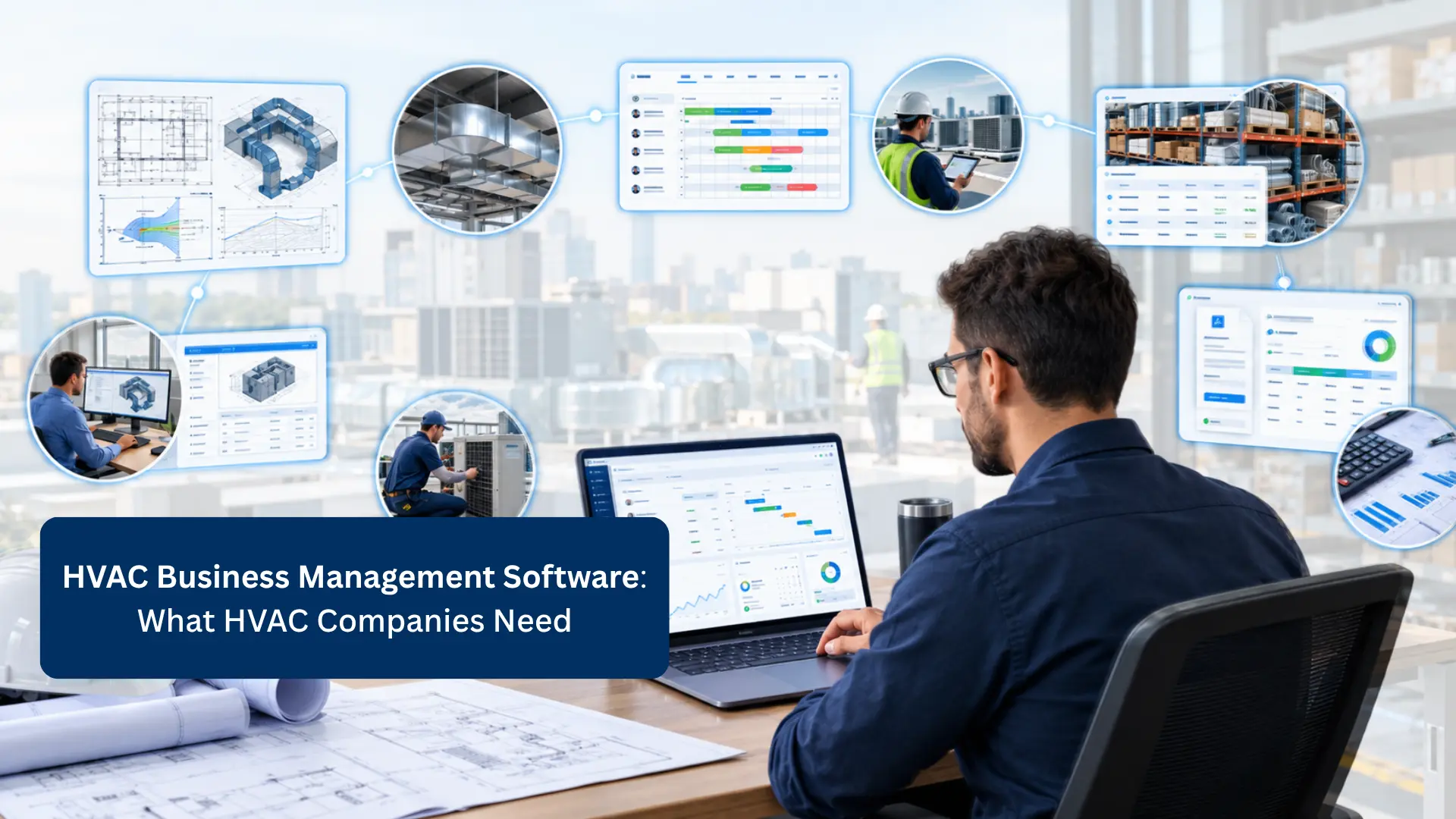
HVAC businesses manage a chain of work that starts with an enquiry and can continue through estimating, project execution, material purchasing, field activity, invoicing, accounting, and maintenance. The challenge is not simply handling each task. The harder part is keeping information connected as responsibility moves between sales, engineering, project teams, purchasing, field staff, finance, and service.
More HVAC Work. More Moving Parts. One Missed Detail Can Hit Your Margin.Projects, materials, quotes, payments, and field teams become harder to control as an HVAC company grows. DuctArchitect connects these core workflows so contractors can manage the business without chasing information across separate systems. HVAC Business Management Software helps manage:
WhatsApp Now Become a Distributor Get 14 days of full access with no credit card required. |
HVAC business management software can address that coordination problem by bringing related workflows into one operating environment. The value depends on how well the system reflects the actual sequence of HVAC work rather than how many unrelated features appear on a product page.
Key Takeaways
- HVAC business software can connect sales, technical, project, inventory, service, financial, accounting, compliance, and workforce workflows.
- HVAC-specific capabilities such as heat load calculation and duct sizing address requirements that general business platforms may not cover.
- Project controls can include BOQ, BOM, task assignment, progress tracking, project files, expenses, and reporting.
- Inventory and purchasing functions can organize suppliers, purchase orders, stock movement, returns, and project materials.
- Service workflows can cover AMC, warranty and service contracts, visits, tasks, customer assets, and service billing.
- Financial and accounting capabilities can cover invoices, payments, expenses, ledgers, banking, reconciliation, GST-related records, and financial reporting.
- Field operations can include attendance, associate activity, site locations, and mobile application access.
- Software selection should be based on actual HVAC workflows and handoffs rather than feature count alone.
These takeaways are supported by the catalogue's documented modules and capabilities.
What Does HVAC Business Management Software Manage?
HVAC business management software manages the connected activities required to run an HVAC company, including sales, HVAC calculations, projects, materials, service, finance, accounting, compliance, and workforce operations. The objective is to keep these business functions organized within one operating environment instead of handling each activity through disconnected processes.
Business area | Core activities |
| Sales | Enquiries, customer records, quotations, follow-ups |
| HVAC operations | Heat load calculation, duct sizing, calculation reports |
| Projects | Planning, BOQ, BOM, tasks, progress, files, expenses |
| Inventory | Items, suppliers, purchasing, stock, project materials |
| Service | AMC, service contracts, warranty contracts, visits, assets, billing |
| Finance | Invoices, payment status, expenses, financial reporting |
| Accounts | Chart of accounts, ledgers, vouchers, banking, reconciliation |
| Compliance | GST records, statutory details, financial statements, reporting |
| Workforce | Attendance, field activity, site locations, mobile access |
These areas correspond to the modules documented in the DuctArchitect catalogue.
How does the system handle sales and customer management?
A connected sales workflow keeps enquiries, customer details, quotations, invoicing, and payment follow-up within the same commercial process. This helps sales teams maintain context as a potential job moves from initial enquiry to quotation and then billing, while reducing the need to recreate customer or transaction information at each stage.
DuctArchitect's CRM includes:
- Inquiry and Lead Management: Captures enquiries and keeps potential jobs moving through the sales process.
- Customer & Contact Records: Connects customer information with related sales activity.
- Professional Quotations: Provides pricing controls for consistent project proposals.
- Quote-to-Invoice: Converts accepted quotations into invoices without rebuilding the same information.
- Payment Follow-Up: Tracks receivables and supports payment reminders and follow-ups.
The catalogue describes this workflow from the first customer inquiry through quotation, invoicing, and payment follow-up.
How Does HVAC Calculation Software Support Heat Load and Duct Sizing?
HVAC estimating software can support engineering preparation by bringing key calculation activities into the design workflow before project execution. DuctArchitect provides a Heat Load Calculator for heating and cooling requirements, Duct Sizing based on airflow and friction-loss requirements, and Calculation Reports for organizing results used in HVAC design and project planning.
DuctArchitect's documented HVAC calculation capabilities include:
- Heat Load Calculator: Calculates heating and cooling requirements using building dimensions and other load factors.
- Duct Sizing: Calculates duct dimensions based on airflow and friction-loss requirements.
- Calculation Reports: Keeps calculation results organized for HVAC design and project planning.
Accurate load and duct calculations help organize HVAC design requirements before project execution.
How Does HVAC Project Planning and Cost Tracking Software Support Project Management?
HVAC project management software should help teams control project stages, responsibilities, material requirements, documentation, expenses, budgets, timelines, and progress from planning through execution. A structured project workflow gives managers clearer visibility into assigned work and project status while keeping important records connected to the job.
DuctArchitect's Projects & Management module includes:
- Project Planning & Workflow: Organizes projects through defined stages, tasks, and timelines.
- Bill of Quantities (BOQ): Manages quantities required for project planning and material requirements.
- Bill of Materials (BOM): Manages the materials associated with project requirements.
- Task & Team Assignment: Assigns work and keeps responsibilities clear.
- Progress & Status Tracking: Tracks completion status, priority, and timelines.
- Project Files & Activity: Connects drawings, documents, updates, and activity records to the job.
- Expenses & Budget Control: Tracks project expenses alongside budget information.
- Project Views & Reports: Provides List, Kanban, and Reports & Analytics views.
This structure gives HVAC teams clearer project management visibility from planning to completion.
How Does HVAC Inventory Management Software Track Materials and Purchasing?
HVAC inventory management software helps HVAC businesses organize materials from item setup and supplier purchasing through stock movement and project allocation. A useful inventory workflow gives teams clearer visibility into what is available, what has been ordered, what has been delivered, and which materials are connected to specific jobs, helping them manage purchasing and stock more systematically.
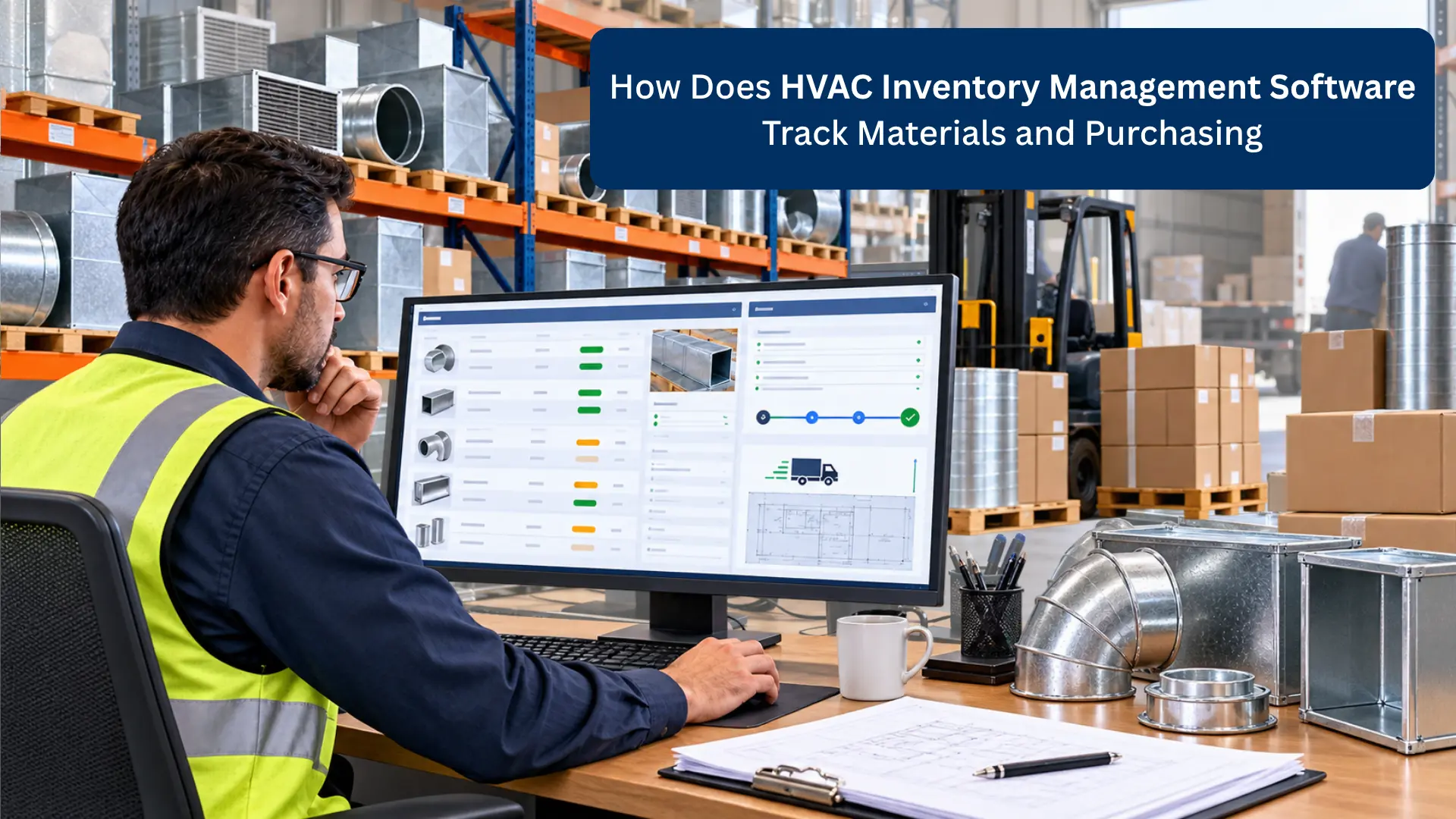
DuctArchitect's Catalog & Inventory module includes:
- Item Catalog: Maintain item details, categories, brands, models, and current stock status so teams can identify materials consistently.
- Suppliers & Purchasing: Manage suppliers, purchase orders, PO payments, deliveries, and purchase returns within the purchasing workflow.
- Inventory Control: Track stock levels, stock-outs, and returnable items as materials move through the business.
- Project Materials: Connect required materials with individual projects so teams can relate inventory needs to specific jobs.
- ABC Analysis: Review items according to their importance to support more informed inventory decisions.
These functions give HVAC teams a more structured way to manage inventory and material movement.
How Does HVAC AMC and Service Contract Management Software Support Maintenance?
HVAC service management software helps maintenance teams organize recurring service work by connecting contracts, scheduled visits, assigned tasks, customer information, equipment assets, and service billing. This gives teams a structured way to manage planned and overdue visits while keeping service requirements connected to the customers and equipment they support.
DuctArchitect's Service & Maintenance module includes:
- Annual Maintenance Contracts (AMC): Manage AMC records alongside service and warranty contracts so recurring maintenance commitments remain organized.
- Service and Warranty Contracts: Keep different types of customer service agreements available within the maintenance workflow.
- Visit Scheduling: Organize upcoming service visits and monitor scheduled maintenance activity.
- Overdue Visit Tracking: Identify visits that have passed their scheduled date and require attention.
- Service Task Assignment: Assign maintenance tasks to team members and monitor their status.
- Client & Asset Records: Keep customer and equipment information connected to the service work.
- Service Billing: Manage billing related to service and maintenance contracts.
- Service Templates: Use saved templates to standardize recurring service activities.
An Annual Maintenance Contract (AMC) defines the maintenance services to be delivered over an agreed period, making contract and visit tracking an important part of service management.
How Should You Evaluate HVAC Business Management Software?
Choosing HVAC business management software becomes easier when you test it against the work your team handles every day. Instead of judging a platform by its feature count, trace a real job from enquiry and quotation through project execution, material control, billing, service, and reporting. This shows where the software fits your workflow, where information can stay connected, and where manual work may still be required.
Use these practical checks before making a decision:
- Workflow fit: Map the actual path of work from enquiry to project completion and identify where teams currently switch between tools or records.
- Ease of adoption: Check whether office and field users can understand the workflow without creating additional administrative work.
- Information continuity: Confirm that important records remain connected as responsibility moves between teams.
- Reporting visibility: Review whether managers can obtain the operational and financial information needed for routine decisions.
- Field accessibility: Check whether the platform suits employees who work across offices, project sites, and customer locations.
- Business growth: Consider whether the system can accommodate additional users, workers, projects, and operational requirements as the company expands.
- Workflow demonstration: Test the platform using a real business scenario rather than relying only on screenshots or a feature list.
A practical software evaluation should measure how well the system fits the way the HVAC company actually works.
How Does HVAC Contractor Software Differ From Generic Business Software?
HVAC contractor software is designed around the technical and operational work that HVAC companies perform alongside everyday business administration. A general business platform may manage contacts, tasks, or finances, but an HVAC-focused system can also support heat load calculations, duct sizing, BOQ and BOM, project materials, service contracts, and field operations within the same business workflow. DuctArchitect documents these HVAC-specific areas alongside CRM, projects, inventory, service, finance, accounts, compliance, and workforce functions.
Relevant HVAC-specific capabilities include:
- Heat load calculations: Supports calculation of heating and cooling requirements from building information.
- Duct sizing: Calculates duct dimensions using airflow and friction-loss requirements.
- BOQ and BOM: Helps organize project quantities and material requirements.
- Project materials: Connects required materials with project records.
- Service contracts: Supports AMC, service, and warranty contract management.
- Field operations: Covers attendance, associate activity, site locations, and mobile access.
These capabilities make HVAC software more closely aligned with the day-to-day requirements of HVAC contractors, consultants, ducting businesses, and service teams.
How Can Connected HVAC Workflows Reduce Delays, Duplicate Work, and Lost Information?
Connected HVAC workflows solve a common operational problem: information often moves between sales, engineering, purchasing, project teams, finance, and service through separate records. A connected process keeps each handoff tied to the relevant job or customer, making it easier to see what has been quoted, planned, purchased, completed, billed, or scheduled next. DuctArchitect is structured around this connected workflow model.
A practical workflow can look like:
Enquiry → Customer Record → Quotation → Project → BOQ/BOM → Materials → Tasks → Progress → Expenses → Invoice → Payment
A recurring maintenance workflow can follow:
Service Contract → Scheduled Visit → Assigned Task → Client/Asset Record → Service Activity → Service Billing
Where the problem is reduced
- Lost customer context: Enquiries, customer records, quotations, and payment follow-up remain part of the sales workflow rather than being scattered across separate records.
- Unclear project responsibility: Project stages, tasks, team assignments, progress, files, and expenses give the project team defined information to work from.
- Material uncertainty: Suppliers, purchase orders, deliveries, returns, stock records, and project materials provide a structured purchasing and inventory process.
- Delayed service follow-up: Contracts, visits, assigned tasks, client and asset records, and service billing keep recurring maintenance work organized.
- Disconnected financial information: Invoices, payment status, expenses, accounting records, and reconciliation connect financial activity with the wider business process.
These workflows are based on the CRM, Projects & Management, Catalog & Inventory, Service & Maintenance, Financial, and Accounts capabilities documented in the DuctArchitect catalogue.
Can HVAC Business Software Support Different HVAC Business Models?
HVAC businesses do not all follow the same workflow. A contractor may focus on project execution and field teams, while a ducting business may rely more heavily on duct sizing and material planning. Consultants need calculation and client information, whereas maintenance teams depend on contracts, visits, and assets.
The software should therefore match the work each business performs.
HVAC business type | Relevant workflow needs |
| HVAC contractors | Manage enquiries, projects, field teams, inventory, invoicing, and accounting. |
| Ducting businesses | Manage duct sizing, heat-load work, materials, projects, and billing. |
| HVAC consultants | Organize calculations, project information, client records, and reporting. |
| Service and maintenance teams | Manage service contracts, visits, technicians, clients, and assets. |
| Growing HVAC businesses | Add users, workers, projects, inventory, and operational functions as requirements expand. |
The problem is solved by matching software workflows to the business model instead of forcing every HVAC company into the same process.
How Does HVAC Accounting Software Connect Invoicing, Expenses, and Financial Control?
Financial problems in HVAC businesses often appear when project costs, invoices, payments, expenses, and accounting records are maintained separately. A connected financial workflow keeps these records organized within the wider business process, helping teams monitor what has been billed, what has been paid, which expenses have been recorded, and where accounting differences need attention.
How the financial workflow addresses common problems
Business problem | Relevant capability | How it helps |
| Unclear invoice status | Invoices and payment status | Shows whether amounts are paid, partially paid, pending, or overdue. |
| Expenses difficult to monitor | Expense management | Records business expenses so financial activity is easier to review. |
| Accounting records spread across processes | Chart of Accounts and Ledgers | Organizes account structures and detailed transaction records. |
| Transaction recording is inconsistent | Vouchers | Provides a structured method for recording accounting transactions. |
| Bank records do not match accounts | Banking and Reconciliation | Helps compare accounting records with banking activity and identify differences. |
| Management lacks financial visibility | Reports & Analytics | Provides financial information for review and operational decision-making. |
DuctArchitect's Financial module covers invoices, payment status, expenses, and financial reporting, while its Accounts module covers the chart of accounts, ledgers, vouchers, banking, and reconciliation.
How does compliance fit into the financial workflow?
The Compliance & Reports module includes GST registration and classification, statutory details, payroll voucher types, financial statements, and business reports. GST, or Goods and Services Tax, is specifically documented as part of the platform's statutory compliance functionality.
How Can an AI Assistant Help HVAC Businesses Query Business Data?
An AI Assistant can make business information easier to access by allowing HVAC teams to ask questions in plain language instead of writing SQL queries or creating technical database reports. This can help managers and operational teams obtain answers from business data more directly, particularly when they need information without depending on technical users to build each query.
How can the AI Assistant be useful?
- Ask questions naturally: Users can ask questions about business data using everyday language rather than technical query syntax.
- Get answers faster: Questions can be directed to the business data without manually constructing SQL queries.
- Reduce technical dependency: Non-technical users do not need SQL knowledge to formulate data questions.
- Access business insights: The assistant is designed to provide answers and insights directly within the DuctArchitect environment.
For HVAC teams, this kind of AI interface can make business data easier to query and understand without requiring every user to work with technical reporting tools.
Conclusion
A strong HVAC platform should fit the way the business actually operates, from customer enquiries and technical preparation through project execution, material control, service work, financial records, and field activity. The evaluation should focus on whether these workflows are practical for the teams using them and whether the information remains organized as work moves from one stage to the next.
DuctArchitect brings these business functions into defined areas covering CRM, Projects & Management, HVAC Tools, Catalog & Inventory, Service & Maintenance, Financial, Accounts, Compliance & Reports, and Associates. The catalogue also presents an AI Assistant designed to let users query business data through natural language.
FAQ
1. What reports should HVAC ERP software provide for business decisions?
Useful reporting should help teams review operational and financial information rather than requiring them to examine individual records one by one. DuctArchitect includes Reports & Analytics within project management and Business Reporting within Compliance & Reports, giving users dedicated views for reviewing business information.
2. What Is the Difference Between HVAC ERP Software and HVAC Business Management Software?
HVAC ERP software connects multiple business functions within one system, while HVAC business management software focuses on managing the operational workflows of an HVAC company. In practice, the two terms can overlap when a platform combines sales, projects, HVAC calculations, inventory, service, finance, accounting, compliance, and workforce operations in one connected environment. DuctArchitect's catalogue covers these business functions across its documented modules.
3. How can HVAC management software help with stock-priority decisions?
Inventory decisions are not always about current stock quantity. DuctArchitect includes ABC Analysis, which allows businesses to review inventory according to item importance. This can help teams focus attention on items that require greater consideration when making stock decisions.
4. What accounting records can HVAC contractor software organize?
Accounting workflows can require more than invoices and payments. DuctArchitect's Accounts module includes a chart of accounts, ledgers, vouchers, banking records, and reconciliation, providing a structured environment for maintaining transaction records and comparing accounting information with banking activity.
5. How can HVAC project management software help teams review active work?
Project review becomes easier when the same project can be viewed in different formats. DuctArchitect provides List, Kanban, and Reports & Analytics views, allowing teams to examine active work according to the type of project information they need to review.
6. What should HVAC estimating software preserve after calculations are completed?
Calculation results should remain organized so they can be referenced during design and project planning. DuctArchitect includes Calculation Reports alongside its Heat Load Calculator and Duct Sizing capabilities, creating a documented place for calculation results rather than treating each calculation as an isolated activity.
7. What does HVAC inventory management software need to track beyond stock levels?
Inventory control can involve items that are purchased, delivered, returned, allocated to projects, or temporarily returnable. DuctArchitect documents stock-outs and returnable items alongside suppliers, purchase orders, deliveries, purchase returns, and project materials.
8. How can HVAC service management software handle recurring service work?
Recurring service work can require consistent handling across multiple visits and customer requirements. DuctArchitect includes saved templates for recurring service work, allowing teams to standardize repeated maintenance activities instead of preparing each recurring service process from scratch.
9. What payroll-related records can HVAC accounting software support?
Payroll-related accounting may require defined voucher categories in addition to general transaction records. DuctArchitect includes Payroll Voucher Types within its Accounting & Payroll area and also provides access to financial statements for reviewing business accounts.