Home/Blog/How to Cut Your HVAC Quote Turnaround Time to Under 2 Hours Without the Owner
How to Cut Your HVAC Quote Turnaround Time to Under 2 Hours Without the Owner
September 2, 2026
Dr. Rajesh Rolen
5 min read
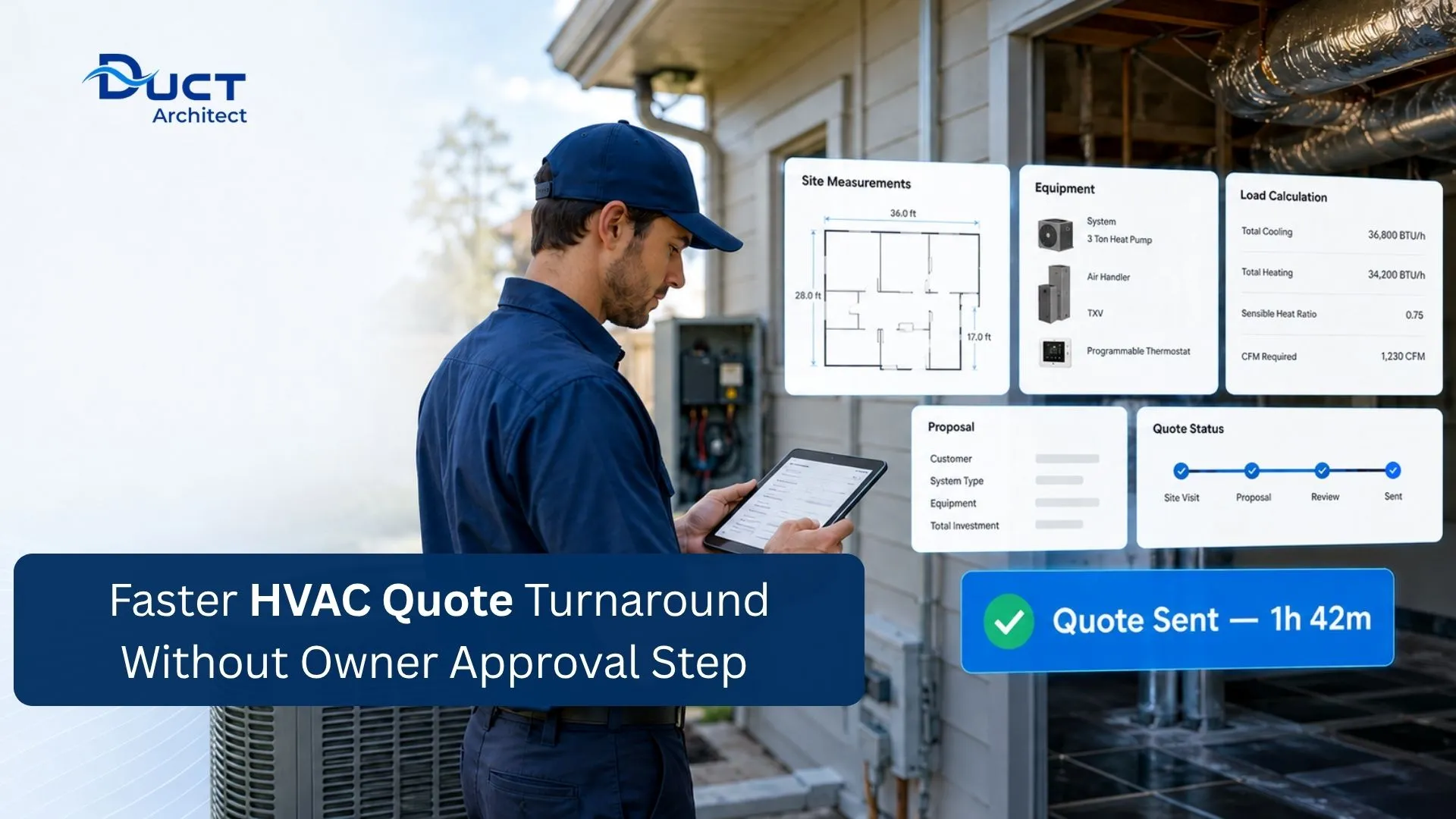
If you are still the only person who can turn a site visit into a sent proposal, you have a process problem, not a staffing problem. The bottleneck is almost never your team's capability, it is the absence of a defined workflow that tells them exactly what data to capture on site, how to size the system accurately, and when they have authority to send the proposal without calling you first.
Two-Hour Quotes Can Win Jobs. Waiting on the Owner Can Lose Them.
Slow quote approvals create a gap between customer interest and your sales team’s next move. DuctArchitect CRM lets teams capture inquiries and prepare quotes faster, so qualified leads keep moving while the owner stays out of every step.
Get 14 days of full access with no credit card required.
Most contractors lose jobs not because their price is wrong, but because a competitor's proposal arrives first, and slow hvac estimating is usually the real reason why. This guide gives you the exact process framework to compress your turnaround time to two hours or fewer, using your existing crew, without sacrificing the engineering accuracy that keeps callbacks off your schedule.
Key Takeaways
Getting a proposal out in under 2 hours is achievable without owner involvement when every crew captures the same site information the same way.
Skipping a load calculation before quoting a new install is the single biggest source of callbacks and warranty claims on residential and light-commercial jobs.
Written approval limits, not just a mobile quoting app, are what actually remove the owner bottleneck from the proposal process.
A Good-Better-Best structure lets a project coordinator present three priced options without needing the owner to judge which system fits the client.
Residential changeout proposals can realistically reach a client within 2 hours; light-commercial multi-zone jobs should target the same business day, not the same hour.
The Two Root Causes of a Slow Quote
Before redesigning your process, you need to identify which problem you actually have, because the fix is different for each. A slow HVAC quote almost always traces back to one of two root causes. The first root cause is missing site data. The technician returns from the visit without the measurements, equipment model numbers, duct condition notes, or room-by-room information needed to produce an accurate price. The proposal stalls in the office while someone tries to fill the gaps by phone or schedules a second visit. This is an information-capture problem. The second root cause is owner-gating. The data is all there, but nothing goes out until you personally review and approve it. If you are in the field, at lunch, or on another call, the proposal sits. This is a process-authority problem.
Most contractors who buy mobile quoting software solve only the delivery speed after approval, not the approval step itself, and not the upstream data quality. If the tech came back without a proper measurement of the return-air plenum or the linear footage of duct runs, a faster app does not help. You still end up doing the job yourself. Fix both, in order. Standardize what gets captured on site first. Then define who has authority to send what, and under which conditions. Only then does quoting software add its full value. A useful check: look at your last five proposals that took more than 24 hours. How many stalled because of missing measurements versus waiting for your approval? That ratio tells you which problem is costing you more.
Two Categories, Not One: Residential vs. Light-Commercial Timelines
A residential changeout, with an existing duct system, the same footprint, and a replacement unit, can realistically reach the client within 2 hours of the site visit. A light-commercial multi-zone job, where duct sizing changes with the scope, should target the same business day. The same discipline applies whether you are pricing residential heating and cooling quotes or a multi-zone commercial retrofit; conflating these two job types leads to unrealistic expectations and process designs that fail one or the other.
What the Tech Must Capture on Site to Produce an Accurate Quote Back at the Office
An accurate price starts with accurate site data. Standardizing site visit data capture across every tech is what actually prevents the back-and-forth delay that stalls a proposal in the office.
For residential new-install or changeout jobs, collect:
Square footage and ceiling height by zone
Window count, orientation, and glazing type (single, double, low-e)
Insulation levels in attic, walls, and crawlspace
Existing equipment model, serial numbers, and condition
A photograph of the electrical panel showing available breaker slots and service amperage
For light-commercial jobs, add:
Floor plan sketch with room labels and dimensions
Occupancy type and hours per zone
Ventilation requirements and existing make-up air equipment
Duct routing path and linear footage per run
This data enables an ACCA Manual J calculation back at the office without estimation. Use a single-page site visit form, paper or digital, that produces consistent output from every tech on every job. Form variation creates price variation.
Manual J Load Calculation as a Non-Negotiable Step Before Pricing
No competitor page in the current search results treats a standards-based load calculation as a prerequisite for pricing. They all assume a price book is sufficient. It is not, for new installs. A Manual J calculation, even a simplified one, is what connects the site data to a correctly sized system and a defensible price. Running the hvac manual j calculation does not need to be complex, but it does need to be non-negotiable before you price a new install. Price-book-only quoting on new installs is what generates oversized systems and comfort complaints.
Free Manual J calculators found online are useful for a quick sanity check, but they rarely account for duct condition, access constraints, or window glazing the way a full site visit does. DuctArchitect, the HVAC business management and ERP platform, provides HVAC calculators and tools built to support this step directly.
Building a Delegation Framework: Tiered Approval Thresholds That Remove the Owner Bottleneck
A clear, written authority structure eliminates owner-gating more effectively than any software. Set explicit rules for when your project coordinator or senior tech can send a proposal independently. This written matrix is what makes hvac quoting without owner approval possible in practice, rather than just a verbal habit.
Tier 1: Project coordinator sends without review:
Residential like-for-like equipment replacement, same tonnage, existing duct system in good condition
Total priced value under $8,000
Existing account with no outstanding disputes
Tier 2: Senior tech drafts, coordinator reviews, no owner required:
Residential new install or system upgrade with a completed load calculation
Total priced value $8,000 to $20,000
Good-Better-Best structure with pre-approved equipment tiers
Tier 3: Owner reviews before sending:
Any light-commercial job with duct modifications
Total priced value above $20,000
Any job requiring engineering sign-off or permits
Set thresholds based on your average job size and coordinator capability. Pairing this authority structure with Good-Better-Best proposals removes another layer of involvement: clients choose from three pre-built options rather than requiring your judgment on equipment tier, efficiency, and warranty. Review the features of DuctArchitect to see how proposal templates and approval workflows support this delegation structure.
The Good Better Best HVAC Quote Format Coordinators Can Send Confidently
A Good-Better-Best format pre-answers the question your coordinator would otherwise escalate to you: which system should we recommend? Good covers the code-minimum efficiency unit with a standard warranty. Better adds a higher SEER rating and extended parts coverage. Best includes the premium unit, an extended labor warranty, and an IAQ add-on. Each tier is pre-priced from your approved equipment list, so no one needs to call you to build it.
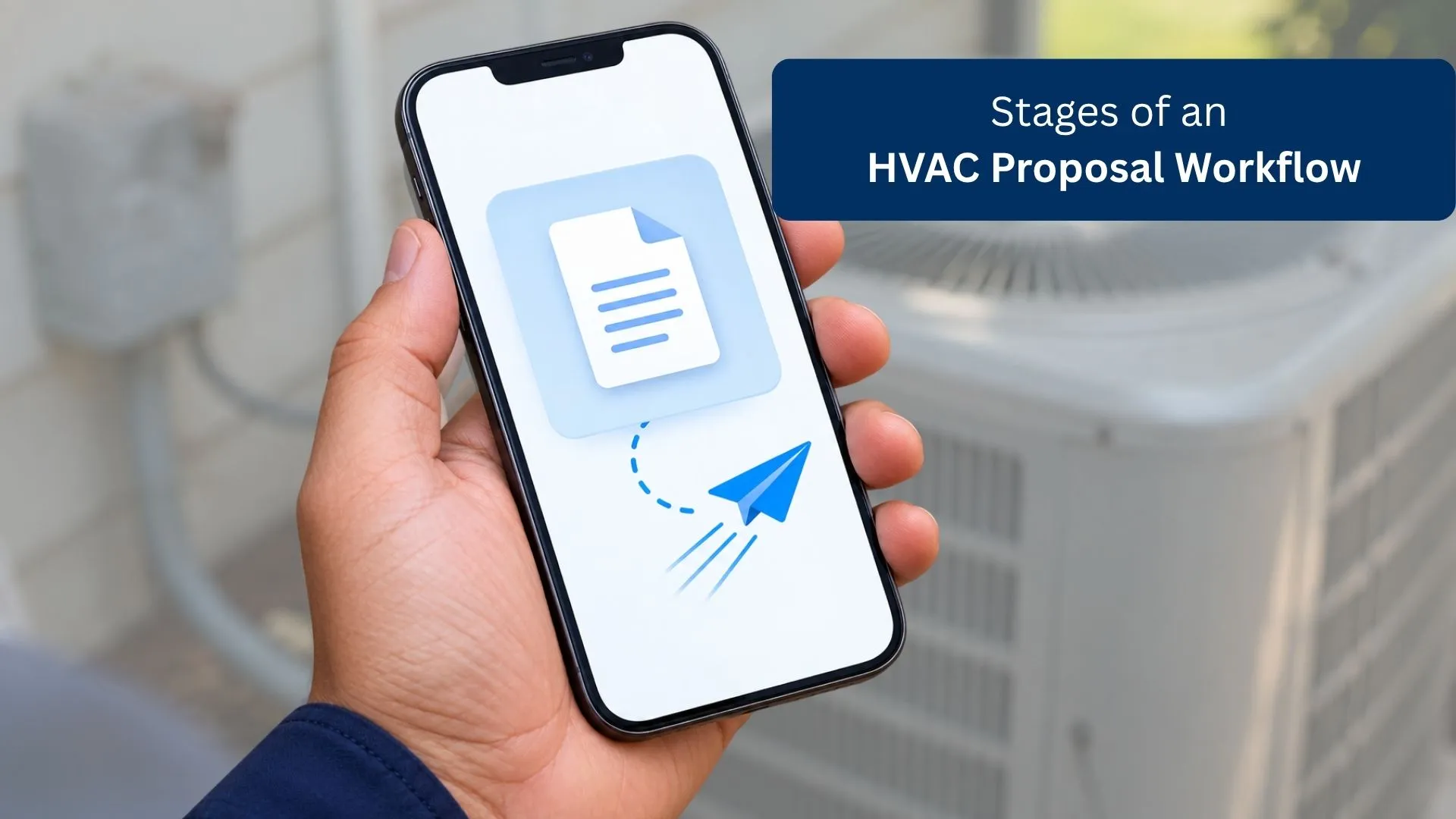
Stages of an HVAC Proposal Workflow: Site Visit to Sent Quote in Two Hours
With standardized site data capture and a clear delegation framework, the two-hour target becomes a scheduling problem, not an expertise problem. Every quote for HVAC system replacement should move through the same four stages: site visit, load calculation, coordinator build, and tiered review. The tech completes the site visit using the standardized form, photographs every relevant element, and submits the record before leaving the property. The coordinator pulls the site record, reviews the load calculation, and selects equipment from the pre-approved price book. The coordinator builds the proposal using the Good-Better-Best template, attaches the load calculation summary as a supporting document, and checks it against the delegation rules. For Tier 2 jobs, a second review takes five minutes before sending. The client receives a complete, engineered proposal the same afternoon.
For commercial multi-zone jobs, batch the duct layout and load calculation into a two-hour block that afternoon rather than queuing it for the next day. Track turnaround time per job type each week. If residential changeouts hit four or five hours, the bottleneck is site data, not pricing. If commercial jobs slip to two or three days, the bottleneck is usually duct design.
Conclusion
Reducing your turnaround time to under two hours is a process change before it is a software change. Standardize what gets captured on site, run the load calculation as a non-negotiable step, and set written authority thresholds so your coordinator can send without waiting for you. If you want one platform that connects the site data, the load calculation, the proposal, and the job record without re-entering anything, take a look at the pricing and plans for DuctArchitect'sHVAC business management and ERP software.
FAQs
1. How do you put together an accurate quote after an HVAC site visit? Capture standardized site data, run a Manual J calculation, price from a pre-approved equipment list, then send under your tiered approval rule. Skipping the load calculation step is the most common reason quotes come back inaccurate on new installs.
2. How long should it take to receive a quote after a site visit? For a residential like-for-like replacement, a well-run contractor should send a proposal within 2 hours of the site visit. Light-commercial multi-zone jobs with duct modifications realistically need the same business day. Anything beyond that usually points to missing site data, an approval bottleneck, or both.
3. How accurate is Manual J? Manual J is highly accurate when every input is measured rather than estimated: square footage, insulation levels, window glazing, orientation, and duct condition. Accuracy drops sharply when a tech skips fields or guesses at access constraints, which is why standardized site data capture matters more than the calculation method itself.
4. How do I calculate the HVAC load for my house? A Manual J calculation combines your home's square footage, ceiling height, insulation levels, window count and glazing type, and orientation to determine heating and cooling load room by room. Free online calculators give a rough estimate; a full ACCA Manual J with measured site data gives a code-compliant, defensible number.
5. What tools does a contractor actually need to build a quote? Four tools cover most of it: a standardized site visit form, a Manual J calculation tool, an approved equipment price book, and proposal or quoting software to assemble and send it. Fewer tools than most contractors assume, as long as they are the right four and every tech uses them the same way.
6. How do you remove the owner bottleneck from the quoting process? Write a tiered authority matrix that specifies exactly which job types and dollar thresholds a project coordinator or senior tech can approve without the owner. Pair this with a Good-Better-Best template so coordinators do not need to make equipment recommendations. The written rule removes the informal default of escalating everything.
7. Can a project coordinator run a Manual J calculation without an engineering background? Yes, with the right inputs and software. Manual J is a structured calculation, not a judgment call, when the site visit data is complete. A coordinator trained on the inputs and given access to a load calculation tool can produce a defensible result. The tech's site capture quality is the critical variable.
8. What should a complete HVAC proposal include for residential and light-commercial jobs? A complete proposal should list the equipment make, model, capacity, and efficiency rating, a Manual J calculation summary, labor hours and access notes, permit and disposal fees, startup and testing, warranty terms, payment terms, and a validity period. Light-commercial jobs should add ductwork modifications and code compliance details as separate line items so the client sees exactly what they are paying for.
9. Does quoting speed actually affect close rates? Yes. In competitive residential replacement markets, the first credible proposal in the client's inbox has a structural advantage regardless of price. Clients who receive a same-day proposal have typically not yet called a second contractor. Delayed pricing gives competitors time to enter the conversation.
10. What is the difference in workflow between a residential changeout and a light-commercial multi-zone job? Residential changeouts use existing duct systems and a fixed footprint, so the load calculation and pricing move faster. Light-commercial multi-zone jobs require duct sizing calculations that change the scope and price materially, which is why they need a same-day target rather than a 2-hour target and typically a second reviewer before sending.
D
Dr. Rajesh Rolen
Published on September 2, 2026
Share:
Enjoyed this article?
Explore more insights and industry knowledge in our blog collection.