Home/Blog/Beyond the Calendar: How HVAC ERP Software Delivers Practical Benefits for Contractors
Beyond the Calendar: How HVAC ERP Software Delivers Practical Benefits for Contractors
August 26, 2026
Dr. Rajesh Rolen
5 min read
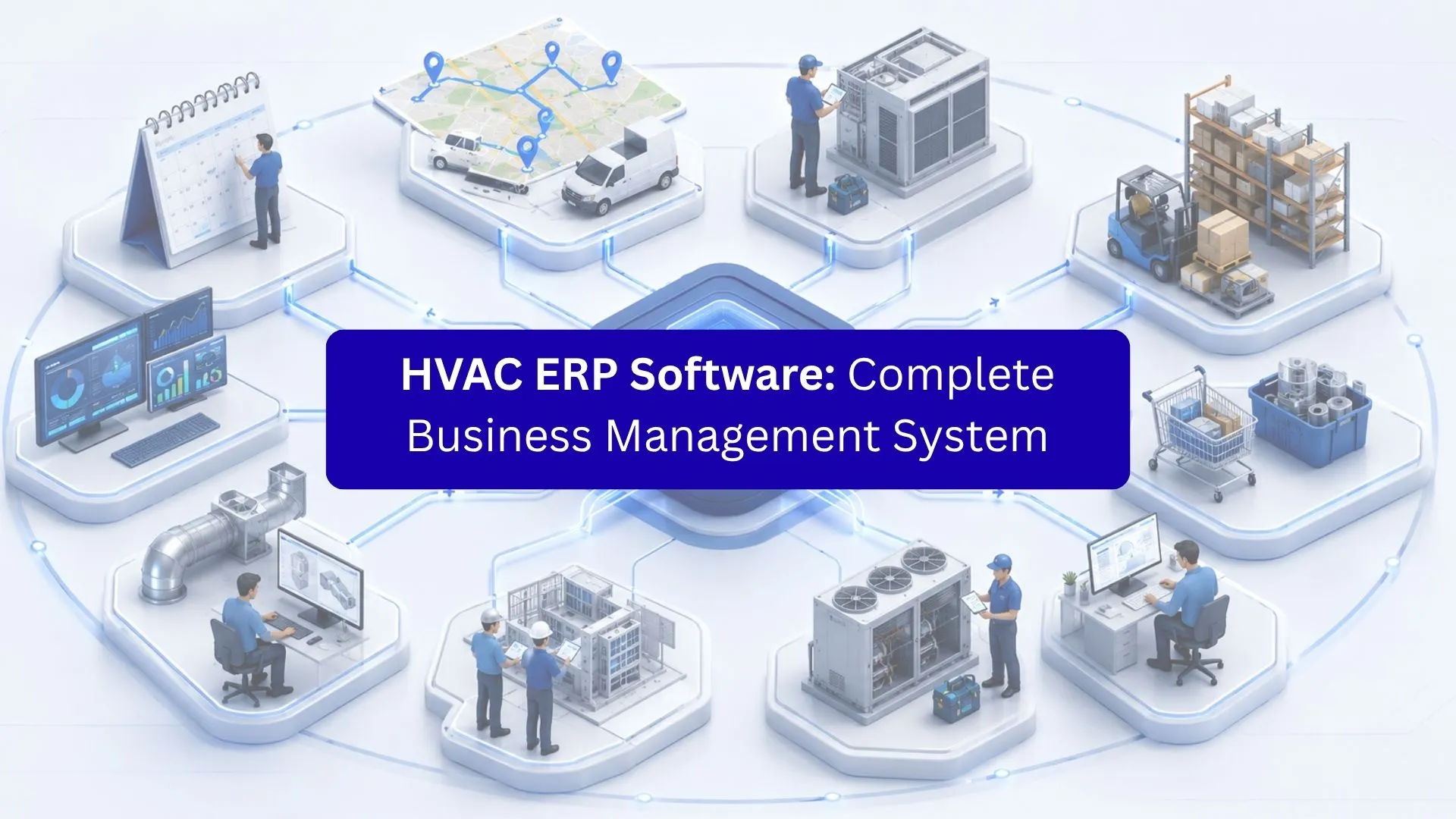
HVAC ERP software is an integrated business management system that brings scheduling, dispatch, field service, inventory, projects, maintenance, and accounting into one business environment. For HVAC contractors, its value extends beyond managing appointments. It gives teams a structured way to manage customer records, job activity, costs, and financial transactions across the business.
A Calendar Can Schedule HVAC Work. It Can't Control the Business Behind It.
Contractors need more than appointments to manage projects, materials, payments, and field teams without losing visibility. DuctArchitect connects those workflows so HVAC Contractors can act on the work, not just schedule it.
Get 14 days of full access with no credit card required.
An HVAC contractor may handle service calls, duct design, field teams, materials, projects, and financial administration at the same time. When those activities rely on separate spreadsheets, applications, or manual handoffs, employees spend more time checking records and transferring details. Duct Architect operates across HVAC business management and duct-design requirements, making this broader approach relevant to contractors evaluating ERP software.
The practical benefits of an integrated HVAC ERP environment include:
More coordinated scheduling and dispatch, with better control over technician assignments, workloads, and job status
Stronger field service administration, keeping relevant job details available to office and field teams
Better inventory and procurement control, including parts, materials, and purchasing requirements
More consistent accounting and invoicing, linking job activity with financial records
More structured maintenance and AMC administration, including recurring service planning and renewal tracking
Better control of project estimates, costs, progress, and completion
A stronger link between HVAC design activities, including load calculations and duct sizing, and project execution
More useful reporting for management decisions and business planning
These benefits show whyHVAC ERP software should be evaluated as more than a scheduling or dispatch application. Its wider value depends on how well it supports the processes that keep an HVAC contractor's business running.
Why HVAC ERP Goes Beyond Scheduling and Dispatch
Scheduling is only one part of dispatch efficiency. Effective service coordination also depends on technician availability, job requirements, location, workload, and changes occurring in the field. HVAC ERP software brings those factors into the same service process, giving dispatch teams more context when assigning or adjusting work.
Connected Job Scheduling and Technician Allocation
An HVAC scheduling platform can assign work according to technician availability, workload, location, skills, and job requirements. A shared schedule gives coordinators a practical view of daily commitments and makes assignment changes easier when priorities shift. The real benefit is matching available resources with the work that needs to be completed.
Better Dispatch Coordination and Route Visibility
HVAC dispatch softwarebecomes more useful when job status, technician locations, and route details are available together. Real-time tracking gives dispatchers additional context when managing urgent requests, delays, or route changes. This makes service coordination software more useful for day-to-day field decisions because the office can respond to current activity instead of waiting for delayed updates.
Real-Time Updates for Faster Field Decisions
Field conditions can change after a technician reaches a site. A job may require additional materials, take longer than planned, or reveal work that was not apparent when the appointment was created. Prompt field updates allow the office to revise assignments and customer communication without rebuilding the schedule from separate records.
How Connected Field Service Information Improves HVAC Operations
Field service depends on accurate job details being available when technicians and service managers need them. A useful service record includes more than an address and appointment time. It can contain equipment details, previous repairs, service notes, parts used, photographs, job scope, and completion information.
ACCA reports thatHVAC technicians spend nearly 25% of their time on non-technical administrative tasks, including searching for customer data and clarifying job orders. That makes access to accurate records a field-service issue, not simply an administrative convenience.
Centralized Work Orders Keep the Job Record Intact
A centralized work order brings the service request, job scope, customer details, technician notes, parts requirements, photographs, and completion status into one record. For HVAC contractors, the record can also contain equipment type, model and serial information, installation details, previous repairs, and maintenance requirements. AField service management system can then serve as a reliable service record instead of forcing employees to reconstruct a job from messages and documents.
Equipment History Gives Technicians More Useful Service Context
A service visit rarely starts without historical context. Previous refrigerant leak issues, compressor model numbers, equipment age, component replacements, fault codes, and maintenance activity can influence how technicians approach a current problem.
Keeping those details accessible through HVAC software gives technicians useful background before troubleshooting. It also gives service managers a stronger basis for identifying recurring equipment problems and reviewing previous corrective work.
Faster Information Sharing Strengthens Service Coordination
Effectiveservice coordination software carries field updates into the office process. When a technician records a diagnosis, parts used, additional work required, or completion status, relevant details become available to teams responsible for customer communication, billing, procurement, or follow-up.
The result is a more dependable service record that supports the next action without requiring every department to maintain its own version of the job.
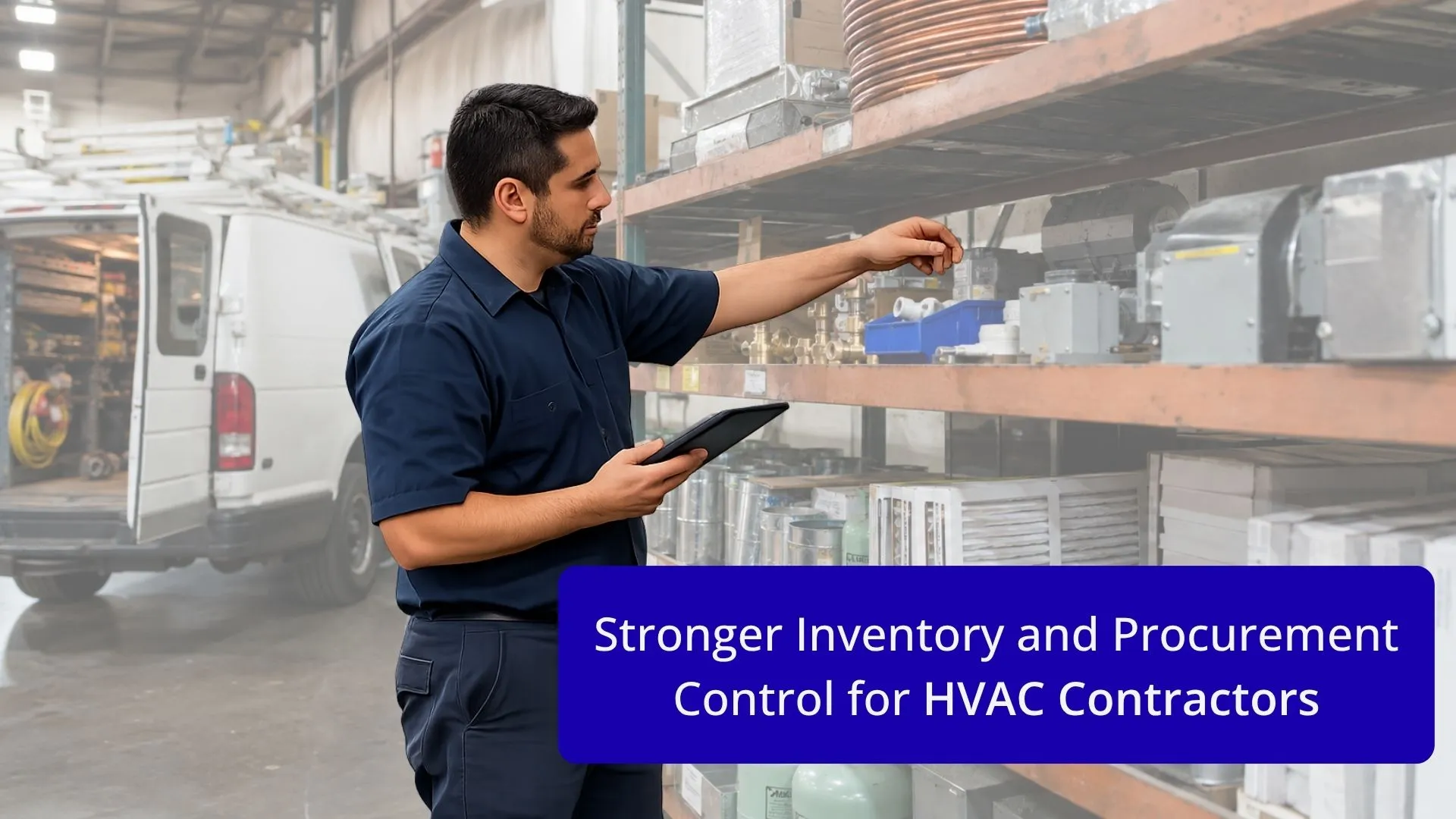
Stronger Inventory and Procurement Control for HVAC Contractors
Inventory affects job readiness and working capital. HVAC contractors may hold service parts in a warehouse, project materials at a storage location, and additional stock in technician vehicles. Without an accurate view of available, committed, in-transit, and issued materials, purchasing decisions become harder to control.
The Association for Supply Chain Management (ASCM) notes that inventory carrying costs commonly range from 10% to 35% of inventory value annually, depending on the industry. These costs can include capital, insurance, storage, handling, taxes, and inventory risk.
Better Visibility Into Parts, Materials, and Stock Levels
An HVAC ERP system can maintain a centralized inventory record for items such as filters, copper tubing, fittings, motors, compressors, electrical components, duct materials, installation accessories, and refrigerants. Stock can be tracked by warehouse, branch, project, or technician vehicle, allowing contractors to distinguish warehouse inventory from truck stock and identify materials already committed to work.
Refrigerant inventory requires additional care. In the United States, EPA Section 608 rules include recordkeeping requirements related to refrigerant management, and EPA guidance describes inventory tracking by refrigerant type for material-balance calculations. Contractors should configure inventory and recordkeeping procedures around the requirements that apply to their operations.
Smarter Purchasing and Reorder Planning
Effective procurement starts with a reliable picture of current stock and upcoming requirements. An HVAC ERP software solution can bring stock levels, committed materials, purchase orders, and job requirements into the same purchasing process.
Inventory planning should also distinguish between critical and slow-moving stock. ASCM describes inventory stratification as a method of classifying stock using factors such as business value, demand, and profitability. Applying that principle allows contractors to use different stocking and reorder policies instead of treating every part the same way.
Linking Materials to Jobs and Project Requirements
Material control becomes more useful when items are associated with service calls, estimates, or projects. Contractors can identify which parts have been allocated, what has been issued, what remains available, and which materials still require purchasing.
For a commercial HVAC installation, that may involve duct materials, equipment, fittings, electrical components, and other project supplies across several stages. Linking those requirements with inventory records gives project managers a stronger basis for confirming material availability before installation work reaches the field.
Connected Accounting and Financial Operations
HVAC contractors generate financial transactions throughout the job lifecycle. Estimates establish expected revenue, purchases create costs, labor contributes to job expense, completed work moves into billing, and customer payments affect receivables. When those activities remain separated, accounting teams spend more time reconciling records before they can assess a job's financial position.
ERP brings those transactions into a broader business process, giving contractors a consistent basis for tracking revenue, costs, invoices, receivables, and project performance.
Linking Job Costs With Invoicing and Accounts
Job costs can include materials, labor, subcontracted work, equipment, and other project expenses. Associating those costs with the relevant job makes it easier to compare expected and actual spending and connect completed work with billing.
ForHVAC contractors, this is particularly relevant on installation and commercial projects where costs accumulate across several stages before final invoicing.
Reducing Gaps Between Operational and Financial Data
When technicians, project teams, inventory staff, and accountants work in separate records, the same transaction may have to be entered or reconciled more than once. An HVAC ERP software integration aligns job activity with accounting processes so that customer details, invoices, payments, job costs, and transaction status remain consistent across the business.
For businesses using accounting platforms such as Tally or QuickBooks, Duct Architect can be evaluated for how its accounting capabilities fit with job, project, and business processes. The important question is not simply whether an integration exists. Contractors should verify which records synchronize, how frequently data is exchanged, whether updates flow in both directions, and how exceptions are handled.
Clearer Financial Visibility Across HVAC Operations
Financial records become more useful when owners and managers can assess revenue alongside job costs, purchasing activity, project performance, and outstanding receivables. That gives management a stronger basis for decisions about pricing, spending, project profitability, and resource allocation.
The value is broader than faster accounting. It is the ability to evaluate financial results in the context of the work that produced them.
How HVAC ERP Connects Maintenance, Projects, Design, Reporting, and Business Growth
HVAC contractors also manage recurring maintenance agreements, installation projects, engineering calculations, management reporting, and increasing business complexity. These requirements go beyond day-to-day service scheduling and financial administration.
A broader business platform gives management a practical structure for handling these areas without creating a separate system for every new requirement.
More Structured Preventive Maintenance and AMC Management
Recurring maintenance requires control over service intervals, contract terms, scheduled visits, customer records, equipment history, and renewal activity.
Key benefits include:
Planned preventive maintenance schedules
AMC contract and renewal tracking
Recurring service reminders
Visibility into completed and pending maintenance
Better coordination between contractual service and billing activity
This gives contractors a structured way to manage recurring obligations rather than relying only on manual reminders.
Better Control of HVAC Projects From Estimate to Completion
Installation and commercial HVAC projects involve several stages, including estimating, engineering, procurement, execution, progress tracking, and billing. Keeping those stages aligned gives project teams a stronger understanding of what has been planned, what has been completed, and where costs are accumulating.
An integrated project process can connect:
Estimates and quotations
Project scope and requirements
Material requirements
Project progress
Labor and job costs
Customer billing
Project completion records
This creates continuity across project administration instead of treating each stage as a separate activity.
Connected HVAC Design and Engineering Workflows
HVAC design introduces technical information that affects downstream commercial activity. Heat-load calculations, duct sizing, equipment selection, and design decisions influence estimating, material planning, installation, and project execution.
Heat-load calculations, duct sizing, and equipment details become more useful when the resulting data reaches the teams responsible for estimating and project delivery. For example, anHVAC Duct Calculator or DUCT SIZING SOFTWARE process can contribute to later planning when design results are carried into the appropriate project activities.
For Duct Architect, this connection is relevant because the platform operates across HVAC business management and duct-design requirements rather than treating engineering as an isolated activity.
Clearer Reporting for Better Business Decisions
Management reporting becomes more useful when the underlying records come from consistent business processes. Owners and managers can review revenue, job costs, inventory activity, project progress, maintenance workload, technician activity, and outstanding financial items within one reporting environment.
Useful reporting areas include:
Job and project profitability
Outstanding invoices and receivables
Inventory movement and purchasing
Maintenance workload and AMC status
Technician and service activity
Project progress and operational bottlenecks
The purpose is not to generate more dashboards. It is to give decision-makers reliable figures for identifying problems, comparing performance, and deciding where attention is required.
Greater Scalability for Growing HVAC Contractors
Growth increases the number of jobs, employees, customers, projects, locations, and records that a business must manage. More technicians increase coordination requirements, additional projects increase administration, and multiple locations create greater pressure for consistent procedures.
An HVAC ERP system provides a common structure for handling increased complexity without turning every new business requirement into another spreadsheet or separate application.
For growing contractors, scalability can involve:
Standardized processes across teams
Consistent customer and business records
Easier management across departments
Less manual data entry
More structured processes as job volume increases
The practical advantage is consistency. Growth becomes easier to administer when processes remain disciplined as the organization becomes more complex.
HVAC ERP Benefits Compared With Standalone HVAC Software
Standalone HVAC applications and ERP systems address different levels of business complexity. A field service management system primarily handles scheduling, dispatch, work orders, technician updates, and service visits. An ERP extends beyond that field-service layer by linking activity with inventory, purchasing, projects, invoicing, accounts receivable, accounts payable, and the general ledger.
The fundamental difference is not the size of the feature list. It is whether the business maintains a common data structure or repeatedly moves records between separate applications.
Integrated Workflows Connect Field Operations With Back-Office Processes
A standalone field service platform records appointments, work orders, service notes, and completion status. ERP links those events with the processes that follow.
A completed HVAC service job, for example, can progress through parts usage, labor records, customer billing, payment status, and accounting without requiring employees to reconstruct every transaction manually.
A Unified Data Structure Reduces Duplicate Information
Separate applications frequently maintain their own customer, job, inventory, or financial records. Moving details between them may require exporting, importing, copying, or reconciling records.
A unified ERP data structure keeps core business records available to authorized processes. That reduces duplicate entry and makes it easier to maintain consistency when customer, job, transaction, or status details change.
Broader Financial Visibility Extends Beyond Field Service
Field service software can show completed jobs and technician activity. ERP connects those activities with billing, receivables, payables, purchasing, job costs, and the general ledger.
This is where a purpose-built platform such as Duct Architect takes a broader approach than a generic field-service tool. Duct Architect describes itself asHVAC business management software designed specifically for HVAC businesses rather than as a generic field-service product adapted to the trade.
For contractors, that distinction matters when the business needs operational activity and financial outcomes to remain part of the same management process.
A standalone HVAC application can still be suitable when a contractor needs a focused solution for one function. ERP becomes more relevant when separate applications create duplicate work, inconsistent records, limited cross-department access, or repeated reconciliation.
When HVAC ERP Creates the Most Value for Contractors
HVAC ERP software becomes more relevant as the complexity of running the business increases. Employee count alone does not determine the need. Job volume, service frequency, project complexity, recurring contracts, multiple teams, and the amount of data moving between departments provide stronger indicators.
Software Advice reports that 36% of field-service software buyers use manual methods, while nearly 36% use non-specialized tools such as CRM and accounting platforms to manage their work. Among those buyers, 52% identify inefficiency as a primary pain point with their existing approach. These findings are based on buyer interactions and are not intended to represent the entire market.
ERP becomes more relevant when the organization needs consistent handling for a larger service workload instead of adding more spreadsheets and disconnected workarounds.
Installation and Project-Based HVAC Contractors
Installation and project-based contractors face a different growth pattern. Commercial HVAC projects can involve estimating, engineering, purchasing, labor, subcontractors, progress tracking, customer billing, and final financial reconciliation.
ERP creates value when those activities must remain coordinated throughout the project lifecycle and when project administration becomes too complex for isolated records.
Commercial and Growing HVAC Enterprises
Commercial HVAC enterprises often manage larger teams, locations, projects, service agreements, warehouses, and financial processes. As those relationships multiply, management needs consistent procedures and reliable records across the organization.
At this stage, ERP software for HVAC contractors becomes increasingly relevant because standardized processes provide a structured way to manage complexity across departments and operating units.
Practical Signs That an HVAC Business Has Outgrown Disconnected Tools
A contractor should examine the case for ERP when several of these conditions appear:
The same customer or job details are entered into multiple systems.
Employees regularly reconcile conflicting records before making decisions.
Management depends on separate spreadsheets to assemble reports.
Job volume creates increasing administrative work without stronger process control.
Multiple teams need access to the same business records.
Project, service, maintenance, and financial processes increasingly overlap.
New locations or teams require administrative workarounds.
Existing software handles individual functions well but does not support the wider business process.
The strongest signal is not company size by itself. It is whether the complexity of running the HVAC operation has outgrown the ability of manual processes and separate tools to maintain consistent records and efficient administration.
What to Evaluate Before Choosing HVAC ERP Software
Choosing ERP software for HVAC contractors requires more than comparing feature lists. The system should fit the company's actual processes, support the functions that require shared records, and remain practical for the employees who use it every day.
The evaluation should begin with business requirements and real processes before moving into pricing or demonstrations.
HVAC Workflow and Industry Fit
Document the processes the business needs the system to support, including service management, project delivery, maintenance contracts, inventory, accounting, estimating, and HVAC design where relevant.
A suitable ERP software for the HVAC industry should reflect how the contractor actually operates rather than forcing essential activities into a generic structure. For Duct Architect, the evaluation should also consider whether design and engineering requirements need to coexist with the company's broader business processes.
Integration, Data Migration, and Implementation Requirements
Integration quality determines how well an ERP fits the existing technology environment. Contractors should identify which accounting platforms, payment systems, communication tools, and other applications need to exchange data.
Data migration requires equal attention. Customer records, equipment details, open jobs, inventory balances, historical transactions, and other business records may need to move into the new system. Buyers should establish what can be migrated, how the data will be validated, and who will resolve inconsistencies before implementation.
Mobile Access, Support, and User Adoption
HVAC teams work across offices, warehouses, customer sites, and field locations, so usability is a practical selection criterion. Technicians need access to job-related details, while office and management teams need interfaces suited to their responsibilities.
Before selecting an HVAC ERP software solution, evaluate mobile usability, training requirements, technical support, user permissions, documentation, and post-implementation support. A capable system delivers limited value when employees cannot adopt it consistently.
Testing Real Workflows During an HVAC ERP Software Demo
AnHVAC ERP software demo should test actual business scenarios rather than rely on a guided feature tour. Ask the provider to demonstrate activities that reflect the contractor's real processes, such as creating an estimate, progressing a project, recording field activity, updating inventory, generating an invoice, and reviewing the resulting financial information.
The evaluation should also include exception cases such as schedule changes, incomplete jobs, material shortages, revised project requirements, duplicate records, and failed data synchronization.
The strongest selection process tests the ERP against real processes, data requirements, users, and growth plans. That makes it easier to distinguish genuine fit from features that look useful in a demonstration but do not solve the contractor's actual problems.
Beyond ERP: Additional Resources Available From Duct Architect
The value of an HVAC ERP platform can extend beyond the core software when the provider also offers practical resources for everyday HVAC work. Duct Architect complements its platform with HVAC-specific tools, templates, educational content, engineering utilities, and partnership opportunities. These resources give contractors additional ways to handle common business and technical tasks.
HVAC Templates for Everyday Business Administration
TheHVAC Tools library includes an HVAC Invoice Template, HVAC Service Report Template, HVAC Air Balance Report, and HVAC Maintenance Contract Template. These resources can help contractors standardize routine documentation and provide useful starting points for common administrative tasks.
HVAC Calculators for Costing and Engineering Decisions
The same resource library includes calculators for HVAC load requirements, net profit, markup, and labor cost. Duct Architect also provides a dedicatedfreeHVAC duct size calculator that uses inputs such as airflow and friction loss to calculate round and equivalent rectangular duct dimensions.
These tools can support preliminary engineering and business calculations without requiring contractors to build each calculation from scratch.
HVAC Business and Technical Knowledge From the Duct Architect Blog
TheHVAC-focused articles cover subjects such as heat-load calculations, duct design, HVAC business operations, billing, system design, industry trends, and contractor-specific topics. The resource library gives HVAC professionals another place to research technical and business questions alongside their software requirements.
A Broader HVAC Platform for Businesses That Need More Than One Tool
TheDuct Architect platform combines HVAC business functions such as CRM, quoting, invoicing, field operations, inventory, AMC management, project management, accounting, reporting, mobile access, and HVAC design features. Its feature information also covers heat-load calculations, duct design, GPS workforce tracking, inventory control, maintenance, Tally integration, and business analytics.
Contractors should still verify the specific functions, integrations, permissions, and configuration options relevant to their business before adoption.
Opportunities for HVAC Distributors and Industry Partners
Duct Architect also offers a partner program for organizations and professionals working with HVAC businesses. Itsdistributor program is intended for approved partners serving regional contractor networks, while its affiliate path is designed for people who refer the platform to their audience.
For contractors, the broader value is not limited to ERP functionality. The combination of business software, HVAC-specific calculators and templates, technical resources, and industry-focused services creates a wider resource ecosystem around everyday HVAC work.
Conclusion
HVAC ERP software becomes increasingly valuable when contractors need to manage service, projects, inventory, accounting, maintenance, design, and reporting without allowing administrative complexity to grow at the same pace as the business. The right platform should improve control over day-to-day processes while giving owners and managers reliable data for business decisions.
Selecting ERP should be based on actual business requirements rather than feature count. Contractors should assess HVAC-specific fit, integrations, implementation effort, usability, support, scalability, and real-world workflow performance. Duct Architect adds value to that evaluation with HVAC-focused software, calculators, templates, technical resources, and business tools that extend beyond the core ERP platform.
FAQs
1. What are the main benefits of HVAC ERP software?
The main benefits are greater coordination across business functions, stronger record control, better financial visibility, more structured maintenance and project administration, and improved support for business growth. The value depends on the contractor's operating model and level of complexity.
2. How does HVAC ERP software improve scheduling and dispatch?
It brings job requirements, technician availability, field status, and scheduling details into the same service process. This gives dispatch teams more context when assigning work or responding to changes during the day.
3. Can HVAC ERP software connect accounting with field operations?
Yes. An ERP can connect job activity with billing and financial processes, allowing contractors to relate operational transactions to costs, invoices, payments, and accounting records.
4. Can HVAC ERP software support AMC and preventive maintenance?
Yes. ERP can organize recurring service schedules, AMC records, maintenance intervals, renewal activity, and related customer and equipment details. Contractors should confirm exactly how these functions are configured in the system being evaluated.
5. How can ERP software help commercial HVAC contractors?
It provides a framework for coordinating project administration, service activity, inventory, financial processes, and management reporting when commercial work involves multiple stages, teams, and cost categories.
6. What should contractors check during an HVAC ERP software demo?
They should test real business scenarios rather than only viewing individual features. Key tests include estimating, project progression, field updates, inventory changes, invoicing, accounting synchronization, maintenance, reporting, and exception handling.
7. Is Duct Architect an HVAC ERP software solution?
Yes. Duct Architect positions its platform as an integrated solution for HVAC business management and duct-design workflows. The platform brings areas such as HVAC design, sales, field service, inventory management, accounting, project coordination, and maintenance into a broader business-management environment.
Contractors should still evaluate Duct Architect against their specific processes, reporting requirements, user roles, integration needs, data-migration requirements, implementation resources, and future growth plans.
8. Where can I find free HVAC templates for invoices, service reports, and maintenance contracts?
Free HVAC templates are available for common contractor tasks such as invoicing, service reporting, air-balance documentation, and maintenance contract preparation. Duct Architect provides these resources to help HVAC businesses standardize routine documentation without creating each document from scratch.
9. Where can I use a free HVAC duct size calculator online?
A free HVAC duct size calculator helps contractors, engineers, and HVAC professionals estimate duct dimensions using airflow and other design inputs. Duct Architect provides a free calculator for preliminary duct-sizing work before final design and installation decisions.
10. Where can HVAC contractors find free HVAC calculators and business resources?
HVAC contractors can find free resources for duct sizing, load calculations, markup, labour costs, net profit, invoicing, service reporting, and maintenance documentation. Duct Architect brings these practical resources together alongside its HVAC business-management platform.
D
Dr. Rajesh Rolen
Published on August 26, 2026
Share:
Enjoyed this article?
Explore more insights and industry knowledge in our blog collection.