
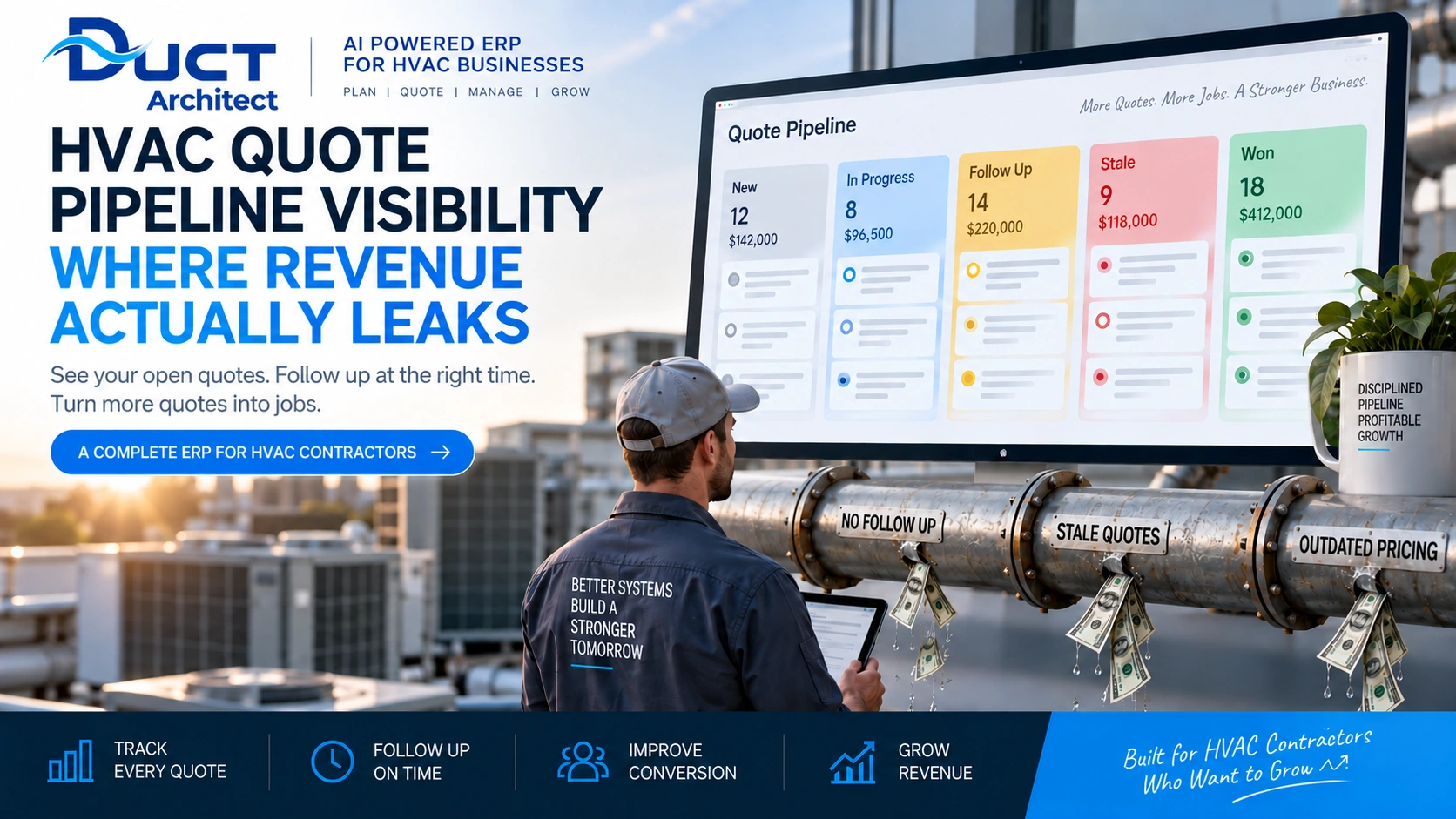
HVAC quote pipeline visibility exposes stale quotes and inaccurate values draining your revenue. Discover how one system fixes both problems.

HVAC quote pipeline visibility exposes stale quotes and inaccurate values draining your revenue. Discover how one system fixes both problems.
If you feel like you're running blind and never really know what's in the pipe, you are not imagining it. Most multi-crew HVAC contractors have the same experience: a mental model of their pipeline assembled from text threads, morning standups, and gut feel. The number looks reassuring until a slow month arrives and you realise half those open quotes were dead weeks ago. HVAC quote pipeline visibility is not just about knowing how many quotes are out there. It is about knowing which ones are accurate, which are still winnable, and which have quietly expired. Those are three very different questions, and most contracting businesses cannot answer any of them reliably.
Most conversations about pipeline problems focus on one failure mode: someone forgot to follow up. That is real, but it is only half the problem. HVAC pipelines lie in two directions at once.
The first lie is volume. Quotes sit in open status long after the customer has moved on, hired a competitor, or shelved the project. Because nobody closed them out, your pipeline looks fuller than it is. You look at $480,000 in open proposals and feel comfortable. Three of those jobs have not had a response in six weeks.
The second lie is accuracy. This one is less obvious and more expensive. A quote built on a rule-of-thumb load estimate rather than a proper Manual J calculation carries a price that does not reflect the actual system the building needs. If that job closes, you are delivering a mis-sized system. If it does not close, the dollar value sitting in your pipeline was wrong from the start. Your revenue forecast is built on a number that was never real.
These two problems compound each other. A pipeline full of stale, inaccurately priced quotes will send you into a slow quarter confident things are fine, then leave you scrambling when the jobs do not materialise or the margins are not there when they do.
Check your open quotes right now. For each one, ask: when did you last get a response from this customer? If the answer is more than three weeks for a residential job or six weeks for light commercial, that quote is almost certainly no longer active. If you cannot answer without making a phone call, that is the visibility gap in plain view.
The structural cause of poor HVAC quote pipeline visibility is a tool problem, not a discipline problem. When your load calculation lives in a spreadsheet, your quote in a Word template, your job status in a group chat, and your invoices in QuickBooks, no single system knows the full picture. Each handoff between tools drops, rounds, or fails to transfer data.
A generic CRM tracks contacts and deal stages but cannot tell you whether the $22,000 replacement quote was sized for a 3-ton or 4-ton system, or whether the square footage was measured or guessed. The pipeline dollar value looks authoritative. It is not.
Spreadsheets hold engineering data but lack workflow. They have no automatic status change when a customer stops responding, no alert when a quote hits 30 days without activity, and no connection between the load calc tab and the job costing row.
The result: you become the pipeline. You remember that the Hendersons went quiet, that the commercial quote needs revision, that the warehouse estimate used outdated equipment pricing. That is not a management system. It is a memory tax on the owner.
The moment a load calculation result is typed manually into a quote template, accuracy is at risk. Transposition errors, outdated equipment pricing, and rounding decisions all enter without a record. When that quote lands in your CRM as a dollar value, nobody can tell from looking at the pipeline whether the number is grounded in a real calculation or a technician's best guess from memory.
Inaccurate HVAC quote pipeline visibility does not just make planning harder. It produces a chain of downstream costs that compound over a quarter.
First, there is the revenue leakage from quotes that were never followed up. A contractor running 15 open quotes at an average of $14,000 each with a typical close rate is looking at significant winnable revenue per follow-up cycle. Quotes that age past 30 days without contact see close rates drop sharply. The revenue does not disappear loudly. It just quietly stops showing up.
Second, there is the cost of winning a job that was priced on bad data. An oversized system runs short-cycle, fails to dehumidify properly, and generates a callback. That callback costs a truck roll, a technician's time, and often a warranty repair. Understanding how invoicing accuracy connects to cash flow shows why the problem does not stop at the quote stage: mis-priced jobs create invoicing disputes and delayed payments downstream.
Third, and hardest to quantify, is the opportunity cost of the owner's time spent reconstructing pipeline status instead of running the business. If you spend 45 minutes every morning figuring out where things stand, that is roughly 185 hours a year of leadership time spent on information retrieval rather than decision-making.
Revenue leakage in an HVAC business is the gap between what you quoted and what you invoiced, plus all the quotes that expired without a follow-up. It shows up as a slow month with no clear cause, a job that closed but came in under budget, or a quarter where volume was fine but cash flow was not. The pipeline looked healthy throughout.
A truthful pipeline gives you three things on demand, without a phone call: the current status of every open quote, the accuracy of the engineering behind each quote value, and the age of each deal so you know which ones need immediate contact.
That requires a single system of record where the load calculation, the quote, the job, and the client record all live together. When the load calc changes, the quote updates. When a quote converts, the job is created from the same data set. Status changes are recorded in the system, not in someone's head.
Duct Architect, the HVAC business management and ERP software, connects the engineering work directly to the commercial workflow so the dollar values in your pipeline reflect actual, calculated system specifications rather than estimates assembled from separate files. For contractors who have already read about unified HVAC business software beyond scheduling, the pipeline angle is the same principle applied specifically to the pre-job commercial phase.
A truthful pipeline also has clean exit rules. Quotes older than a defined threshold get flagged automatically. Deals that convert carry their engineering data into the job file, so the technician in the field is working from the same specification the customer signed off on. Nothing gets re-entered, re-interpreted, or lost at handoff.
Your pipeline is not lying because your team is undisciplined. It is lying because the tools were never designed to tell the truth. Fix the structure and the visibility follows. If you want to see what a connected quote-to-job workflow looks like for a crew your size, see which Duct Architect plan fits your crew size and what each one includes.
How do HVAC contractors track open quotes and follow up on estimates?
Most contractors track open quotes through spreadsheets, CRM stages, or manually maintained lists. Effective follow-up systems flag quotes by age, typically at 7, 14, and 30 days, and assign a named person to each follow-up action. Without automated aging alerts, quotes routinely expire without contact.
Why do HVAC contractors lose quotes they could have won?
The most common cause is no follow-up after the first quote delivery. Research across field-service trades consistently shows that most sales require more than one contact after the initial proposal, yet many contractors make only one attempt. A second cause is a quote value that drifted out of date before the customer decided.
What is a good quote-to-job close rate for HVAC companies?
Close rates vary by market and job type, but residential replacement contractors commonly target a range of 30 to 50 percent on quoted work. New construction and light commercial rates are typically lower due to competitive bidding. Tracking your own rate over time is more actionable than benchmarking against industry averages.
How many follow-up attempts does it take to close an HVAC estimate?
Field-service sales data generally shows that two to four contacts after the initial quote are needed to reach a decision. A practical cadence is contact at day 3, day 10, and day 21. Most contractors stop after one follow-up, which means winnable jobs go to whoever calls back a second time.
How do I know which HVAC jobs in my pipeline are still winnable?
Age and last-contact date are the two most reliable signals. Residential quotes past 30 days without a response are unlikely to close without a price or scope change. Light commercial quotes have longer decision cycles. Any quote where you cannot recall the last customer interaction without checking records is at risk.
What is revenue leakage in an HVAC contracting business?
Revenue leakage is the difference between the revenue your pipeline implied and what you actually invoiced. It includes quotes that expired without a follow-up, jobs that closed under the quoted price due to scope changes, and callbacks that generated unplanned cost after invoicing. It rarely appears as a single identifiable loss.
Can an HVAC owner see which jobs are profitable before they close?
Yes, if the quote is built from a real load calculation and accurate equipment and labour costs. When quotes are priced from rules of thumb, the margin estimate in the pipeline is guesswork. Connecting load calculation data directly to the quote is what makes pre-close profitability visible and reliable.
What CRM do HVAC contractors use to manage their sales pipeline?
Commonly used tools include generic CRMs adapted for field service and purpose-built HVAC business platforms. Generic CRMs track contact records and deal stages but hold no engineering context. HVAC-specific platforms can link load calculation data to quote values, making pipeline dollar figures more accurate.
How does a disconnected quoting process affect HVAC field work?
When the load calculation and the approved quote live in separate files, the technician on site may be working from a specification that differs from what the customer signed. This creates sizing errors, scope disputes, and callbacks that are expensive to resolve. A single connected record eliminates the handoff gap.
Dr. Rajesh Rolen
Published on September 17, 2026