

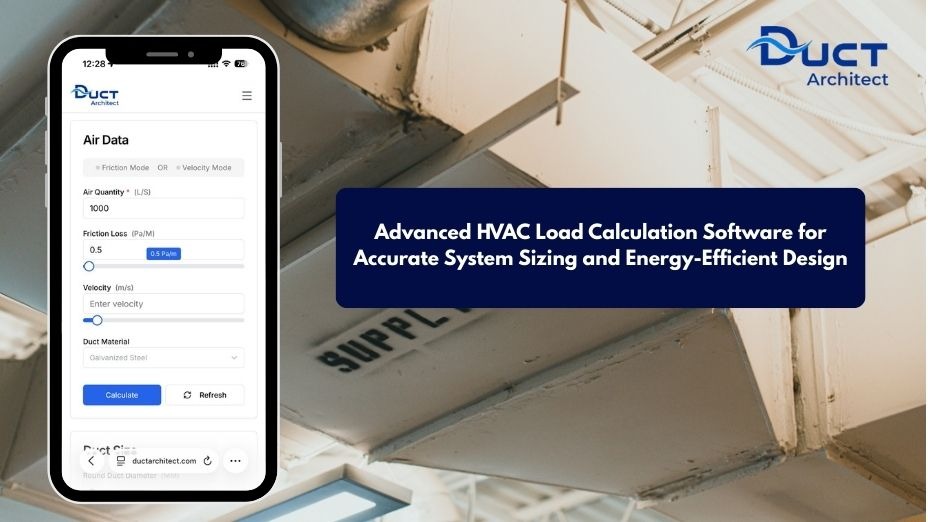
Modern construction, climate control engineering, and energy-efficiency design standards have reached a point where it is no longer acceptable to size HVAC systems using simplistic thumb rules or outdated spreadsheets. HVAC Load Calculation Software allows engineers, HVAC contractors, consultants, and facility designers to simulate and compute thermal loads with high precision using climatological data, envelope characteristics, occupant density, and equipment heat gains.
Still Doing HVAC Load Calculations Manually? Turn Accurate Results Into Faster Project Decisions. A reliable load calculation is the first step toward correct equipment selection and duct design. Use DuctArchitect’s Heat Load Calculator to calculate faster, generate reports, and move prospects closer to a project-ready HVAC solution.
Start 14-Days Free TrialCall Us Now No card needed. Get 14-days of full access. |
In advanced construction markets including India, the UAE, and the USA, regulatory frameworks are progressively mandating more detailed heat load analysis for both commercial and residential projects, making such software indispensable for mechanical design workflows. This trend reflects not only energy cost sensitivity but also an evolving HVAC design ethos that prioritizes lifecycle performance, IAQ (Indoor Air Quality), and environmental responsibility. While the underlying objective, sizing an HVAC system correctly, has not changed, the methodology and tools used to achieve this goal now require advanced computational support, extensive data inputs, and the ability to model dynamic cooling and heating behavior under fluctuating environmental and occupancy conditions.
Understanding HVAC Load Calculations
Accurate load calculation is the foundation of HVAC system design. Before a system can be selected, engineers must quantify heat gains and heat losses occurring through building envelopes, internal loads, infiltration, ventilation, and moisture addition. Historically, load calculation involved manual arithmetic using standardized guidelines such as ASHRAE fundamentals, simplified AC BTU lookup charts, or climate-based air conditioner formula references.
Although viable for basic sizing, these methods often lacked granularity, ignored peak diversity, and did not reflect variable climatic conditions that many buildings experience throughout the day. With increasing demand for energy-efficient buildings in India???s Tier-1 cities, massive cooling requirements in the UAE???s desert climate, and stringent ASHRAE compliance in the USA, accurate load calculation has become non-negotiable. This push toward precision is further supported by government incentives, green building certifications, and corporate sustainability objectives that require HVAC systems to operate at optimal load levels rather than being chronically oversized or undersized.
Key Parameters Considered in Load Calculation
In real-world design, cooling and heating analysis must incorporate a wide spectrum of thermodynamic variables. These include not only the conduction and convection processes occurring through walls, roofs, floors, windows, and glazing systems, but also less obvious thermal contributors such as occupant metabolic heat, equipment heat dissipation, lighting heat gain, and humidity latent loads. Moreover, varying climate conditions influence how to calculate heat load relative to local temperature, solar radiation patterns, and ventilation requirements.
Typical parameters include:
- Geographic climate and weather data
- Building envelope materials and insulation properties
- Window U-values, SHGC, orientation, and shading
- Occupancy density and activity level
- Lighting and appliance heat gain
- Outdoor and makeup air ventilation requirements
- Internal humidity and latent heat contributions
- Infiltration air changes and leakage profiles
- Process loads (in commercial/industrial facilities)
- Thermal storage and heat recovery systems, where applicable
Why HVAC Load Calculation Software Matters
The transition from manual methods to HVAC Load Calculation Software represents more than technological convenience; it represents a shift toward data-driven HVAC engineering. System oversizing has been a chronic issue in many global markets, especially in India and parts of the Gulf region, where contractors often default to over specifying tonnage to avoid customer complaints.
While oversizing provides superficial reassurance, it compromises energy performance, increases cycling losses, reduces equipment lifespan, and degrades humidity control, often leading to uncomfortable indoor environments. Conversely, undersized systems fail to meet thermal comfort requirements during peak conditions, especially during summer heat in the UAE or peak humidity in coastal Indian cities like Mumbai or Chennai. Software-driven cooling load calculation eliminates guesswork and ensures equipment selection aligns with actual thermal loads and psychrometric requirements.
Benefits of Using Software for Cooling Load Calculation
Integrating cooling load calculation tools into HVAC workflows offers measurable gains:
- Higher accuracy and reliability compared to manual calculation
- Ability to model dynamic loads under peak and part-load conditions
- Reduced risk of oversized or undersized HVAC systems
- Compliance alignment with ASHRAE, ISHRAE, and international codes
- Automated AC BTU calculations for diverse building typologies
- Enhanced energy efficiency and lifecycle performance
- Improved indoor air quality and humidity management
- Better documentation for regulatory submissions and LEED/GRIHA rating systems
Heat Load Calculation and Thermal Modeling
Heat load calculation represents the subset of thermal analysis that quantifies how much heat must be removed (for cooling) or added (for heating) to maintain a target indoor temperature. Software platforms calculate heat gain using the heat load calculation formula, which incorporates conduction through building surfaces, solar gains, ventilation, and internal loads. Although HVAC practitioners often rely on simplified air conditioner formula lookups to estimate AC BTU requirements, software solutions make it possible to simulate real-world thermal behavior. This includes peak solar timing, diurnal temperature variations, shading factors, and latent humidity load estimation.
In climatic zones such as the UAE, where outdoor temperatures frequently exceed 45??C, latent loads and solar radiation become dominant design drivers. In contrast, US construction standards emphasize insulation performance, infiltration reduction, and code compliance. Meanwhile, Indian projects often balance cost constraints with increasingly modern air-conditioning expectations in residential and commercial real estate developments.
How to Calculate Heat Load with Accuracy
To demonstrate the difference between rule-of-thumb approaches and software-driven cooling load calculation, consider the following input categories that software typically consumes:
- Building envelope geometry and construction layers
- Surface thermal resistance and insulation data
- Glass and glazing specification datasets
- Climate bin data from meteorological sources
- HVAC zone partitioning and thermal zoning logic
- Ventilation and infiltration profiles based on standards
- Occupant diversity, schedules, and metabolic intensity
- Lighting and equipment schedules for commercial use cases
Heat Load Calculation Formula Overview
In simplified educational contexts, the heat load calculation formula for conduction is often expressed as:
Q = U ?? A ?? ??T
Where:
- Q = Heat Transfer Rate
- U = Overall Heat Transfer Coefficient
- A = Surface Area
- ??T = Temperature Difference
However, relying solely on such a formula ignores solar gain, latent moisture load, ventilation load, infiltration load, equipment load, occupant load, and process loads. HVAC Load Calculation Software integrates all these variables, computes peak conditions, and produces sizing results for compressors, coils, fans, and ductwork. The inclusion of latent heat is particularly crucial in humid climates found across India and the southeastern United States, where comfort failure often occurs not due to temperature mismanagement but inadequate moisture removal.
Limitations of Manual Approximation
Manual heat load estimation is prone to several constraints:
- Assumes uniform climate conditions
- Poor humidity modeling capability
- Limited ability to simulate peak solar timing
- No integration with building automation systems
- No ability to map AC BTU requirement zoning
- No documentation trails for approval and compliance
Services Across India, UAE, and USA Markets
Although the physics governing cooling load calculation remains constant across global regions, real-world design requirements vary significantly based on local climate, regulatory environment, and building technology maturity. In India, the adoption of multi-split VRF/VRV systems in commercial and high-end residential projects has fueled demand for accurate load sizing to avoid energy waste. In the UAE, extremely high cooling loads and near-constant AC operation throughout the year makes software modeling vital for equipment lifecycle cost reduction. In the United States, HVAC system sizing is deeply interconnected with energy codes, LEED documentation, and sophisticated building simulation workflows that already assume access to digital load calculation software. Each region illustrates different drivers but a common dependency on accurate HVAC load computation.
Regulatory Considerations in Load Calculation
Several global standards influence cooling load determination:
- ASHRAE Fundamentals for calculation methodology
- Energy codes (IECC, ASHRAE 90.1, ECBC India)
- Green building certifications (LEED, GRIHA, Estidama)
- Indoor air quality standards (ASHRAE 62.1)
- Mechanical system sizing regulations
Conclusion
Accurate HVAC sizing now demands more than BTU charts or rule-of-thumb estimates. With rising energy standards and competitive efficiency targets, HVAC Load Calculation Software has become essential for modern mechanical design. By modeling climate data, insulation, humidity, occupancy, infiltration, ventilation, and solar gains, it delivers precision manual methods cannot achieve. From India and the UAE to the USA, software-driven load modeling reduces oversizing risk, improves documentation, and supports compliant, energy-efficient system design, making platforms like Duct Architect a practical tool for contemporary HVAC workflows.
FAQs
What is HVAC Load Calculation Software used for?
HVAC Load Calculation Software is used to determine how much heating or cooling a building requires under peak and part-load operating conditions. It evaluates heat transfer, solar gains, occupancy loads, ventilation, infiltration, and internal equipment loads to size HVAC systems accurately.Is cooling load calculation the same as heat load calculation?
Cooling load calculation focuses on removing heat from indoor spaces, whereas heat load calculation may refer to overall thermal load analysis for either heating or cooling. In HVAC design, both terms are often used interchangeably depending on context.Why not use rule-of-thumb AC sizing?
Rule-of-thumb methods are prone to oversizing and undersizing, which lead to high energy consumption, poor humidity control, and increased lifecycle cost. Software-based thermal modeling is more accurate and fully aligned with modern building standards.What does AC BTU mean in HVAC sizing?
BTU (British Thermal Unit) is a unit of heat energy used to quantify cooling or heating capacity. Software converts computed heat loads into required BTUs or refrigeration tons for selecting HVAC systems.Does climate affect load calculation?
Yes. Climate plays a major role in cooling and heating load requirements. Hot-humid climates (Chennai, Houston) have significant latent loads, while desert climates (Dubai, Riyadh) have extreme sensible loads.Can software calculate humidity and latent loads?
Yes. Modern platforms compute both latent and sensible components, which is essential for humidity control and comfort, especially in humid climates.Is load calculation mandatory?
In many jurisdictions, accurate load calculation is required for code compliance, energy certification, or project approval. Even where not mandated, it is considered best practice.Does software support ventilation load analysis?
Yes. Ventilation, infiltration, and outdoor air loads are core components of cooling load calculation and are included in modern calculation engines.Who uses HVAC Load Calculation Software?
Mechanical engineers, HVAC consultants, design-build contractors, energy modelers, facility planners, and sustainability consultants commonly use such software.- What is the output of HVAC load calculation?
Outputs typically include heating/cooling peak loads, airflow requirements, coil sizing, equipment tonnage, and duct sizing data used for final system design.
Dr. Rajesh Rolen
Published on January 23, 2026